

Claude is Anthropic’s family of large language models (LLMs). Anthropic — founded in 2021 by former OpenAI researchers Dario Amodei, Daniela Amodei, and colleagues — built Claude with a distinctive philosophy: safety and capability should not be trade-offs, but complements. That philosophy is baked into every model.
At a basic level, Claude is a conversational AI you can ask questions, give tasks, and treat as a thinking partner. At a deeper level, it is a frontier reasoning system used by enterprises, developers, researchers, and individuals to do everything from debugging distributed systems to drafting investor memos to analyzing scientific literature.
Table of Contents
- Claude AI Timeline: Every Model at a Glance
- The Evolution: Generation by Generation
- Individual Model Deep Dives
- Comparison Tables
- Which Claude Model Should You Choose?
- Case Studies
- Claude for Different Industries
- Efficiency Analysis: Speed, Cost, and Quality
- Common Mistakes to Avoid
- The Future of Claude
- Final Recommendations
- FAQs
Why Claude Matters
Three things set Claude apart from competing AI systems:
Long context. Claude has consistently pushed the frontier on how much text it can process in a single conversation. It was the first frontier model to support a 100K-token context window (May 2023), and current models support up to 1 million tokens — roughly 700,000 words, enough to hold several full-length novels.
Calibrated honesty. Claude is trained to acknowledge uncertainty, avoid confabulation, and maintain consistent values across long sessions. This makes it significantly more trustworthy for research and professional work than models optimized purely for user engagement.
Safety as a feature, not a constraint. Anthropic’s Constitutional AI (CAI) training means Claude models are evaluated not just for capability benchmarks, but for their alignment, honesty, and resistance to misuse. As models like Fable 5 and Mythos 5 reach capability levels that made policymakers nervous, Anthropic’s investment in safety infrastructure becomes the difference between a broadly deployable model and a restricted one.
How This Guide Is Organized
This guide covers every Claude model released since March 2023. The early generations (Claude 1 through Claude 3.7) are covered concisely, with focus on what they introduced and why they mattered. The current generation (Claude 4.x and Fable 5) receives deeper technical treatment, since these are the models you will actually deploy. The guide closes with decision frameworks, case studies, and specific industry recommendations.
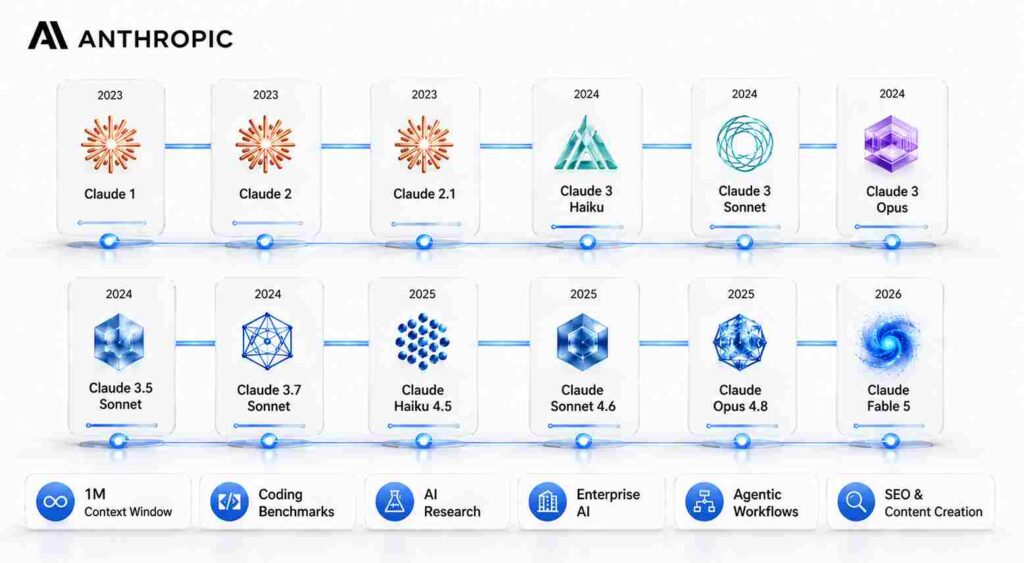
2. Claude AI Timeline: Every Model at a Glance {#timeline}
- MARCH 2023 ─── Claude 1 + Claude Instant
- JULY 2023 ──── Claude 2
- NOVEMBER 2023 ─ Claude 2.1 (200K context)
- MARCH 2024 ──── Claude 3: Haiku · Sonnet · Opus ──── (Three-tier naming introduced)
- JUNE 2024 ───── Claude 3.5 Sonnet (surpassed Opus 3)
- OCTOBER 2024 ── Claude 3.5 Sonnet updated (Computer Use beta)
- NOVEMBER 2024 ─ Claude 3.5 Haiku
- FEBRUARY 2025 ─ Claude 3.7 Sonnet (Extended Thinking)
- MAY 2025 ─────── Claude Opus 4 · Claude Sonnet 4 ────── (1M context beta, new generation)
- AUGUST 2025 ──── Claude Opus 4.1
- SEPTEMBER 2025 ─ Claude Sonnet 4.5
- OCTOBER 2025 ─── Claude Haiku 4.5
- NOVEMBER 2025 ── Claude Opus 4.5
- FEBRUARY 2026 ── Claude Opus 4.6 · Claude Sonnet 4.6
- APRIL 2026 ───── Claude Opus 4.7
- MAY 2026 ─────── Claude Opus 4.8
- JUNE 2026 ─────── Claude Fable 5 · Claude Mythos 5 ─── (Mythos class; new capability tier)
Major Milestones
| Milestone | Model | Date |
|---|---|---|
| First public Claude | Claude 1 | March 2023 |
| First 100K context window in a frontier model | Claude 2 | May 2023 |
| Three-tier family structure introduced | Claude 3 | March 2024 |
| First Sonnet to outperform prior-generation Opus | Claude 3.5 Sonnet | June 2024 |
| Computer Use public beta | Claude 3.5 Sonnet (new) | October 2024 |
| Hybrid reasoning / Extended Thinking | Claude 3.7 Sonnet | February 2025 |
| 1M token context window (beta) | Claude Opus 4 | May 2025 |
| First Sonnet to beat Opus on key coding benchmarks | Claude Sonnet 4.5 | September 2025 |
| Adaptive thinking default across Opus line | Claude Opus 4.6 | February 2026 |
| Dynamic Workflows (parallel subagents) | Claude Opus 4.8 | May 2026 |
| First publicly available Mythos-class model | Claude Fable 5 | June 2026 |
3. The Evolution: Generation by Generation {#evolution}
Generation 1: The Beginning (2023)
Models: Claude 1, Claude Instant
Claude launched in March 2023 as an invite-only research preview. Claude Instant, released alongside it, was a faster and cheaper sibling optimized for lower-latency responses.
What set Claude 1 apart from GPT-3.5 at the time was its notably longer output quality on complex tasks and a measurable refusal to fabricate information. It wasn’t the most capable model on the market, but it was the most honest. That reputation has carried forward through every subsequent generation.
Who it was for: Developers evaluating alternatives to OpenAI’s API, researchers exploring the frontier of safe AI.
Generation 2: Scale and Context (2023)
Models: Claude 2 (July 2023), Claude 2.1 (November 2023)
Claude 2 brought a significant capability upgrade and introduced the first publicly available 100K-token context window — a genuine engineering achievement at the time. You could feed it an entire codebase, a legal contract, or a lengthy research report and get coherent analysis.
Claude 2.1 doubled that window to 200K tokens and addressed a persistent criticism: the tendency of earlier models to confidently state things that weren’t true. Anthropic measured a meaningful reduction in false statements in Claude 2.1 compared to 2.0, which mattered enormously for enterprise deployments where accuracy is contractual.
Limitations: Even at 200K context, Claude 2.x struggled with tasks near the end of a very long context (the “lost in the middle” problem). Coding was good but not state of the art. Reasoning was solid but not yet competitive with GPT-4’s best outputs.
Best use cases: Long-document analysis, customer service, summarization, Q&A over large corpora.
Generation 3: The Competitive Leap (March 2024)
Models: Claude 3 Haiku, Claude 3 Sonnet, Claude 3 Opus
This was the release that established Anthropic as a genuine peer to OpenAI and Google at the frontier. The three-tier naming system introduced here — Haiku (fast), Sonnet (balanced), Opus (best) — persists to this day.
Claude 3 Opus, on its launch day, outperformed GPT-4 on several major benchmarks including MMLU, HumanEval, and MATH. That had not happened before from a non-OpenAI model. It was also the first Claude model with strong multimodal capability: all three variants could process images, charts, and documents.
Claude 3 Haiku, at $0.25 per million input tokens, offered a quality-per-dollar ratio that reshaped how teams thought about AI cost models. You could run Haiku on every customer support inquiry and escalate to Sonnet or Opus only when needed.
Limitations: Claude 3 Sonnet was notably weaker than Opus — a larger gap than subsequent Sonnet/Opus pairs. Haiku’s output length was capped at 4K tokens, limiting it to short-form tasks.
Legacy: Claude 3 Opus was deprecated in January 2026 after being thoroughly superseded. Claude 3 Haiku remains available for cost-sensitive legacy applications.
Generation 3.5: The Efficiency Breakthrough (2024)
Models: Claude 3.5 Sonnet (v1, June 2024), Claude 3.5 Sonnet (v2, October 2024), Claude 3.5 Haiku (November 2024)
Claude 3.5 Sonnet was the most surprising model release in Anthropic’s history to that point: a Sonnet-tier model that outperformed the previous-generation Opus across most benchmarks, at Sonnet prices. This wasn’t an incremental improvement — it was evidence that the cost and capability curves were beginning to decouple.
The October 2024 update to Claude 3.5 Sonnet added Computer Use as a public beta: the ability for Claude to see a computer screen, move a mouse, click buttons, and type. It was rough — 14.9% accuracy on the OSWorld benchmark versus human performance above 70% — but it marked the beginning of a capability trajectory that would reach 85% on the same benchmark with Fable 5 eighteen months later.
Claude 3.5 Haiku delivered near-Claude 3 Sonnet quality at Claude 3 Haiku prices, completing the efficiency story.
Note: Anthropic skipped Claude 3.5 Opus. The jump from Claude 3 Opus went directly to the Claude 4 generation.
Generation 3.7: Thinking Out Loud (February 2025)
Models: Claude 3.7 Sonnet
Claude 3.7 Sonnet introduced Extended Thinking mode — a hybrid reasoning system where the model could spend additional computation on a problem before producing its final answer. The user could see the model’s reasoning chain, adjust the thinking budget, or toggle extended thinking off for speed.
This was a genuine breakthrough for hard reasoning tasks: math olympiad problems, complex debugging, multi-step logic puzzles. Claude 3.7 Sonnet with Extended Thinking regularly outperformed larger models on tasks requiring sustained logical coherence.
Limitations: Extended Thinking was an explicit toggle, not automatic. The model didn’t always know when it needed to think harder. This was the problem that adaptive thinking (introduced in Claude 4.6) was designed to fix.
Generation 4: The Agentic Generation (May 2025 — Present)
Models: Claude Opus 4, Sonnet 4 (May 2025) → Opus 4.1, Sonnet 4.5, Haiku 4.5, Opus 4.5, Sonnet 4.6, Opus 4.6, Opus 4.7, Opus 4.8
The Claude 4 generation represented a strategic pivot as much as a technical one. Anthropic wasn’t just building a better chatbot — it was building AI infrastructure for autonomous software development and long-running enterprise workflows.
Key shifts from the 4.x generation onward:
1M-token context window. The original Claude 4 models launched with a 1 million token context window in beta. By the 4.6 generation it was standard on Opus and Sonnet. You can process entire codebases, multi-year document archives, or months of conversation history in a single context.
Effort control. Starting with Claude Opus 4.6, Anthropic introduced adaptive thinking — the model automatically calibrates how much reasoning to apply based on task complexity. This replaced the manual Extended Thinking toggle. By Opus 4.8, users could explicitly set effort from Low (fast, cheaper) to Max (deepest reasoning) or Ultracode (for dynamic workflows).
Dynamic Workflows. Launched with Opus 4.8, this allows Claude Code to spawn hundreds of parallel subagents to tackle codebase-scale problems: full service migrations, security audits across an entire codebase, test suite generation. The most widely reported example was developer Jarred Sumner using it to port Bun from Zig to Rust — 750,000 lines of code, 99.8% test pass rate, eleven days.
The Sonnet-Opus pricing normalization. A defining feature of the 4.x generation is that Sonnet and Opus now cost $3/$15 and $5/$25 per million tokens respectively. The previous Opus pricing ($15/$75 on early 4.x models) created a 5:1 cost ratio; the current ratio is under 2:1. This changes the economics of when to use which model.
Generation 5: The Mythos Class (June 2026)
Models: Claude Fable 5, Claude Mythos 5
Claude Fable 5 is the most significant model release in Anthropic’s history by capability, and arguably by strategic complexity.
The underlying model — called the Mythos class — is powerful enough that its cybersecurity capabilities raised concerns at the government level. Anthropic’s response was to ship it in two configurations: Fable 5, the public version with safety classifiers that redirect high-risk queries to Opus 4.8; and Mythos 5, the same weights without those classifiers, available only to approved Project Glasswing partners.
This dual-release strategy reflects a broader industry challenge: as AI models approach genuinely expert-level capability in domains like cybersecurity, biology, and chemistry, the question of who should have unrestricted access becomes a policy question, not just a product question.
For most users, Fable 5 is simply the most capable model ever made publicly available, with 95% on SWE-bench Verified and 80% on SWE-bench Pro benchmarks — and it costs twice what Opus 4.8 does.
4. Individual Model Deep Dives {#deep-dives}
Claude Haiku 4.5
Released: October 15, 2025 | Status: Current
Quick Summary: The fastest and most cost-efficient current Claude model. Designed for high-volume, latency-sensitive production deployments.
| Spec | Value |
|---|---|
| Context Window | 200,000 tokens |
| Max Output | 64,000 tokens |
| Input Pricing | $1.00 / million tokens |
| Output Pricing | $5.00 / million tokens |
| Speed | ~97 tokens/second |
| Adaptive Thinking | No |
Strengths:
- Fastest responses in the Claude lineup — designed for sub-second response times in production applications
- 67% cheaper than Sonnet 4.6; 80% cheaper than Opus 4.8
- Near-frontier intelligence per Anthropic’s framing — meaningfully stronger than older Haiku generations
- 64K output cap is sufficient for most short-to-medium task outputs
Limitations:
- No adaptive thinking or extended reasoning
- 200K context window vs. 1M on Sonnet and Opus
- Not suitable for complex multi-step reasoning tasks, architectural decisions, or deep research
Best for:
- Customer support chatbots handling high message volumes
- Real-time in-product AI features (autocomplete, suggestions, classification)
- Background AI processing invisible to users
- Cost-sensitive bulk classification, extraction, or routing tasks
Worst for:
- Anything requiring sustained multi-step reasoning
- Tasks requiring context over 200K tokens
- Complex code generation or architectural design
- Research requiring synthesis of conflicting information
Real Example: An e-commerce platform routes every incoming support message through Haiku 4.5 for intent classification. Of 10,000 daily messages, Haiku handles 8,500 autonomously. The remaining 1,500 complex cases escalate to Sonnet 4.6. Total AI cost: ~$15/day vs. ~$60/day if everything went through Sonnet.
Claude Sonnet 4.6
Released: February 17, 2026 | Status: Current | API ID: claude-sonnet-4-6
Quick Summary: The best all-purpose model in Anthropic’s lineup. Handles 80-90% of professional tasks at 40% lower cost than Opus. The recommended default for most production deployments.
| Spec | Value |
|---|---|
| Context Window | 1,000,000 tokens |
| Max Output | 128,000 tokens |
| Input Pricing | $3.00 / million tokens |
| Output Pricing | $15.00 / million tokens |
| Speed | ~65 tokens/second |
| Adaptive Thinking | Yes |
| SWE-bench Verified | 79.6% |
Strengths:
- Within 1.2 percentage points of Opus 4.6 on SWE-bench Verified (79.6% vs 80.8%) at 40% lower cost
- Full 1M token context window — same as the Opus line
- 128K output window (one of the largest in any model at this price tier)
- Strong coding, writing, analysis, and research performance
- Prompt caching available (up to 90% discount on cached inputs)
Limitations:
- No dynamic workflows (Opus 4.8+ feature)
- Slightly weaker on the hardest reasoning tasks compared to the Opus line
- Knowledge cutoff: August 2025
Best for:
- The vast majority of coding tasks (feature development, debugging, code review)
- Long-document analysis using the full 1M context window
- Content creation, research synthesis, and report writing
- RAG applications where context efficiency matters
- Startups and teams needing high quality at reasonable cost
Worst for:
- Tasks explicitly requiring Dynamic Workflows (parallel subagent orchestration)
- The hardest reasoning problems where Opus’s extra depth is measurable
- Applications needing the absolute latest knowledge cutoff (Opus 4.8: January 2026)
Real Example: A marketing agency processes client campaign briefs through Sonnet 4.6, which reads an entire quarter’s worth of customer data, competitor analysis, and brand guidelines — all within a single 1M context call — and produces a comprehensive strategy document in one shot. The same workflow on Opus 4.8 costs 67% more for indistinguishable output quality.
Claude Opus 4.6
Released: February 5, 2026 | Status: Active (superseded by 4.7, 4.8) | API ID: claude-opus-4-6
Quick Summary: The model that made Opus pricing accessible. $5/$25 vs. the $15/$75 of earlier Opus versions. Brought the 1M context window and adaptive thinking to the Opus tier.
| Spec | Value |
|---|---|
| Context Window | 1,000,000 tokens |
| Max Output | 64,000 tokens |
| Input Pricing | $5.00 / million tokens |
| Output Pricing | $25.00 / million tokens |
| Adaptive Thinking | Yes (introduced here) |
| SWE-bench Verified | 80.8% |
| GPQA Diamond | 91.3% |
Key Contribution: Opus 4.6 introduced adaptive thinking as default behavior — the model now decides automatically how much reasoning to apply per task rather than requiring an explicit “extended thinking” toggle. It also introduced the effort parameter for API developers, allowing explicit control over reasoning depth.
Note: New deployments should use Opus 4.7 or Opus 4.8. Opus 4.6 remains in the API but is not the recommended starting point for new integrations.
Claude Opus 4.7
Released: April 16–17, 2026 | Status: Active (superseded by 4.8) | API ID: claude-opus-4-7
Quick Summary: The upgrade that added better vision, improved memory handling in long sessions, and introduced the xhigh effort level for maximum reasoning depth.
| Spec | Value |
|---|---|
| Context Window | 1,000,000 tokens |
| Input Pricing | $5.00 / million tokens |
| Output Pricing | $25.00 / million tokens |
| SWE-bench Verified | 87.6% |
| SWE-bench Pro | 64.3% |
| AA Intelligence Index | 57.3 |
What Changed from 4.6: Stronger vision and image understanding; better handling of long sessions without quality degradation; introduced the xhigh effort level for the demanding tasks where maximum reasoning is non-negotiable. Also brought measurable improvements in instruction-following on complex, multi-part requests.
Note: Opus 4.8 supersedes 4.7 with better coding, honesty, and alignment at the same price. Migrate to 4.8 for new deployments.
Claude Opus 4.8
Released: May 28, 2026 | Status: Current Flagship Opus | API ID: claude-opus-4-8
Quick Summary: Anthropic’s most capable Opus-tier model. Led the Artificial Analysis Intelligence Index at launch. The right choice for the hardest coding, agentic, and knowledge work tasks that don’t need Fable 5’s full capability.
| Spec | Value |
|---|---|
| Context Window | 1,000,000 tokens |
| Max Output | 128,000 tokens |
| Input Pricing | $5.00 / million tokens |
| Output Pricing | $25.00 / million tokens |
| Fast Mode | Available (3x cheaper than previous fast mode) |
| SWE-bench Verified | 88.6% |
| SWE-bench Pro | 69.2% |
| OSWorld-Verified | 83.4% |
| Online-Mind2Web | 84.0% |
| Terminal-Bench 2.1 | 74.2% |
| AA Intelligence Index | 61.4 |
| Knowledge Cutoff | January 2026 |
What Makes Opus 4.8 Distinctive:
Dynamic Workflows. The flagship feature of this release is available on Claude Code with Max, Team, and Enterprise plans. When you assign Claude a large task (migrate this service, audit this codebase, generate a full test suite), it creates a plan and spawns hundreds of parallel subagents working in parallel, verifying their own work before reporting back. Tasks that would take a team weeks now run as a single instruction in hours.
Honesty and Alignment. Anthropic reports Opus 4.8 is roughly four times less likely to let code flaws pass unremarked than Opus 4.7, and it shows meaningfully lower rates of misaligned behavior. For applications where the model’s judgment is directly in the loop (security audits, legal review, financial analysis), this is a material difference, not an academic one.
Effort Control. Available on claude.ai and through the API: Low (faster, lower rate-limit usage), Medium, High, Max, and Ultracode (triggers Dynamic Workflow behavior for large tasks). Running Low effort on simple tasks and Max on hard ones can reduce monthly costs by 30-50% without touching quality on the tasks that matter.
Computer Use. 83.4% on OSWorld-Verified and 84% on Online-Mind2Web make Opus 4.8 the strongest browser automation model at this price tier before Fable 5’s launch.
Best for:
- Agentic coding: large codebase migrations, service refactors, multi-file debugging
- Security audits, architecture reviews, complex system design
- Long-horizon autonomous tasks in Claude Code
- Applications requiring the January 2026 knowledge cutoff
- Browser automation and computer use workflows
- Complex financial, legal, or scientific analysis
Worst for:
- Simple tasks: Sonnet 4.6 handles most work at 40% lower cost
- RAG and content generation where reasoning depth doesn’t differentiate the output
- Budget-constrained deployments where Haiku 4.5 quality is sufficient
Claude Fable 5
Released: June 9, 2026 | Status: Current Frontier Model | API ID: claude-fable-5
Quick Summary: The most capable model Anthropic has ever made broadly available. The first publicly released Mythos-class model — a new capability tier above Opus. At twice the Opus 4.8 price, it earns its cost on long, complex tasks where it completes work in significantly fewer tokens.
| Spec | Value |
|---|---|
| Context Window | 1,000,000 tokens |
| Max Output | 128,000 tokens |
| Input Pricing | $10.00 / million tokens |
| Output Pricing | $50.00 / million tokens |
| Prompt Cache Discount | ~90% on input |
| Adaptive Thinking | Always on (no toggle) |
| SWE-bench Verified | 95.0% |
| SWE-bench Pro | 80.0% |
| OSWorld-Verified | 85.0% |
| Terminal-Bench 2.1 | 84.3% |
| AA Intelligence Index | 65 |
| Knowledge Cutoff | January 2026 |
Understanding the Fable/Mythos Split:
Fable 5 and Mythos 5 share the same underlying model weights. The difference is safety classifiers: Fable 5’s classifiers detect high-risk queries in cybersecurity, biology, and chemistry domains and redirect them to Opus 4.8 instead. In those sensitive domains, you get Opus 4.8 behavior. For everything else — coding, research, analysis, writing, vision — you get the full Mythos-class capability. Classifiers trigger in under 5% of sessions.
Mythos 5 has the classifiers lifted and is available only to approved Project Glasswing partners through invitation.
Where Fable 5 Separates Itself:
The most important thing to understand about Fable 5 is that its advantage grows with task complexity and length. On a simple 500-token question, the gap between Fable 5 and Opus 4.8 is small. On a multi-hour autonomous task requiring sustained reasoning across a million-token context, the gap is enormous.
Early enterprise case data points this out clearly: Stripe reported a task that normally required two months of engineering effort completed in a single day on Fable 5. The model stays coherent across far longer runs, improves its own outputs using persistent file-based memory, and makes more efficient decisions — completing tasks in fewer turns and tokens than Opus 4.8 on the same work.
The Real Cost Math:
At first glance, Fable 5 at $10/$50 looks like twice the cost of Opus 4.8 at $5/$25. In practice, on complex tasks:
- Fable 5 uses fewer turns to complete the same work
- Prompt caching cuts input cost to ~$1/million for reused context
- A 100K input / 20K output session runs ~$2 on Fable 5 vs. ~$1 on Opus 4.8
- With caching, that Fable 5 session drops to ~$1.10
For tasks where Fable 5 completes work in half the turns, the effective per-task cost is comparable to Opus 4.8.
Best for:
- Tasks where maximum capability is required, period
- Entire codebase understanding and large-scale engineering
- Long-horizon autonomous agents (30+ hours of sustained work)
- Vision tasks: rebuilding apps from screenshots, extracting precise data from scientific figures
- Senior-level financial and legal reasoning
- Scientific research synthesis and hypothesis generation
- Subscription plan users through June 22, 2026 (included at no extra cost during the free window)
Worst for:
- Simple, short tasks where the per-token cost is hard to justify
- Budget-constrained applications
- Domains where safety classifiers redirect to Opus 4.8 anyway (certain cyber/bio/chem queries)
Claude Mythos 5 & Claude Mythos Preview
Released: June 9, 2026 | Status: Restricted (Project Glasswing only)
The same underlying model as Fable 5 without the safety classifiers. Available to a small number of trusted organizations through Anthropic’s Project Glasswing. Not covered in detail here — access is by invitation only through Anthropic, AWS, or Google Cloud account teams.
5. Comparison Tables {#comparison-tables}
Table 1: Complete Claude Model Comparison (Current Generation)
| Model | Release | Context | Output | Input $/M | Output $/M | SWE-bench Verified | Best For |
|---|---|---|---|---|---|---|---|
| Haiku 4.5 | Oct 2025 | 200K | 64K | $1.00 | $5.00 | — | Speed, volume, cost |
| Sonnet 4.6 | Feb 2026 | 1M | 128K | $3.00 | $15.00 | 79.6% | All-purpose, default |
| Opus 4.6 | Feb 2026 | 1M | 64K | $5.00 | $25.00 | 80.8% | Superseded; see 4.8 |
| Opus 4.7 | Apr 2026 | 1M | 64K | $5.00 | $25.00 | 87.6% | Superseded; see 4.8 |
| Opus 4.8 | May 2026 | 1M | 128K | $5.00 | $25.00 | 88.6% | Hard tasks, agents |
| Fable 5 | Jun 2026 | 1M | 128K | $10.00 | $50.00 | 95.0% | Maximum capability |
Table 2: Historical Models Reference
| Model | Release | Context | Input $/M | Status | Notable Feature |
|---|---|---|---|---|---|
| Claude 1 | Mar 2023 | ~9K | Legacy | Deprecated | First public Claude |
| Claude Instant | Mar 2023 | ~9K | Legacy | Deprecated | First fast/cheap tier |
| Claude 2 | Jul 2023 | 100K | Legacy | Deprecated | First 100K context |
| Claude 2.1 | Nov 2023 | 200K | Legacy | Deprecated | Reduced hallucination |
| Claude 3 Haiku | Mar 2024 | 200K | $0.25 | Available | Ultra-cheap frontier |
| Claude 3 Sonnet | Mar 2024 | 200K | $3.00 | Deprecated | Three-tier launch |
| Claude 3 Opus | Mar 2024 | 200K | $15.00 | Deprecated (Jan 2026) | First to beat GPT-4 |
| Claude 3.5 Sonnet | Jun 2024 | 200K | $3.00 | Deprecated | Beat prior-gen Opus |
| Claude 3.5 Haiku | Nov 2024 | 200K | $1.00 | Available | Efficiency upgrade |
| Claude 3.7 Sonnet | Feb 2025 | 200K | $3.00 | Available | Extended Thinking |
Table 3: Coding Performance
| Model | SWE-bench Verified | SWE-bench Pro | Computer Use | Coding Summary |
|---|---|---|---|---|
| Haiku 4.5 | ~40% (est.) | — | Limited | Simple edits, explanations |
| Sonnet 4.6 | 79.6% | — | Moderate | Production coding, debugging |
| Opus 4.8 | 88.6% | 69.2% | 83.4% OSWorld | Large codebases, architecture |
| Fable 5 | 95.0% | 80.0% | 85.0% OSWorld | Autonomous engineering |
| GPT-5.5 (competitor) | ~78.2% (est.) | 58.6% | — | Comparable to Sonnet 4.6 |
Table 4: Content and Knowledge Work
| Model | Writing Quality | Research Depth | Long-Form | SEO Content | Accuracy |
|---|---|---|---|---|---|
| Haiku 4.5 | Good | Surface | Limited by 64K output | Fast drafts | Moderate |
| Sonnet 4.6 | Excellent | Strong | Full (128K output) | Recommended | High |
| Opus 4.8 | Excellent | Expert-level | Full (128K output) | Premium quality | Highest |
| Fable 5 | Best in class | Scientific-grade | Full (128K output) | Maximum | Best in class |
Table 5: Business and Enterprise Suitability
| Model | Customer Support | Analysis | Enterprise Readiness | Cost Efficiency | Agentic Workflows |
|---|---|---|---|---|---|
| Haiku 4.5 | High-volume chatbots | Basic | Good | Best | No |
| Sonnet 4.6 | Complex support | Strong | Excellent | Very Good | Limited |
| Opus 4.8 | Premium support | Expert | Enterprise-grade | Good | Yes (Dynamic) |
| Fable 5 | Autonomous support | Scientific | Enterprise-grade (premium) | Task-dependent | Best |
6. Which Claude Model Should You Choose? {#model-selector}
This table lets you identify the right model in seconds, without reading the full article.
| If You Want To… | Best Claude Model | Why It Wins | When Not To Use It |
|---|---|---|---|
| Automate customer support at scale | Haiku 4.5 | $1/$5/M — handles 85% of tickets autonomously at minimum cost | When tickets require complex reasoning or long context |
| Build a production coding assistant | Sonnet 4.6 | 79.6% SWE-bench at 40% less than Opus; 1M context for whole codebase | When you need multi-file codebase migrations at scale |
| Migrate a large codebase autonomously | Opus 4.8 | Dynamic Workflows + parallel subagents; 88.6% SWE-bench | When cost is the primary constraint (use Sonnet instead) |
| Build an AI agent for complex multi-step work | Opus 4.8 | Dynamic Workflows, 1M context, effort control, 84% browser automation | For simple tasks; Sonnet handles most agentic work cheaper |
| Do maximum capability software engineering | Fable 5 | 95% SWE-bench Verified, 80% SWE-bench Pro — best available | Budget-constrained; Opus 4.8 is 50% cheaper for 90% of the result |
| Write SEO content at scale | Sonnet 4.6 | Excellent writing, 1M context for competitive research, fast output | When you need the highest-quality output; use Opus 4.8 or Fable 5 |
| Write a 100,000-word book | Sonnet 4.6 | 128K output window, strong narrative coherence, cost-efficient | When you need the absolute best prose quality (use Opus 4.8) |
| Conduct academic or scientific research | Fable 5 | Scientific-grade synthesis, 1M context for literature review, best accuracy | When the research is narrow enough for Sonnet 4.6 to handle |
| Analyze entire legal contracts | Sonnet 4.6 / Opus 4.8 | 1M context fits enormous document sets; strong reasoning | Simple contract review: Sonnet. Complex multi-party litigation: Opus 4.8 |
| Build a RAG-based enterprise chatbot | Sonnet 4.6 | Best price-per-quality for inference; 90% cache discount | Ultra-high volume where Haiku 4.5 quality suffices |
| Run data analysis and reporting | Sonnet 4.6 | Strong structured output, analysis, and visualization code | Scientific datasets requiring expert statistical reasoning |
| Classify and route high volumes of text | Haiku 4.5 | 97 tokens/second, $1/$5/M — designed for this use case | Nuanced classification requiring deep reasoning |
| Power a startup’s AI product | Sonnet 4.6 | 80% of Opus quality at 40% less cost; 1M context | When you need to impress with maximum capability (use Opus 4.8) |
| Do browser automation / computer use | Opus 4.8 | 83.4% OSWorld-Verified; 84% Online-Mind2Web | Budget-constrained automation: Sonnet 4.6 handles simpler UI workflows |
| Analyze medical literature | Fable 5 | Best scientific reasoning; 1M context for full literature corpus | Standard clinical protocol lookup (Sonnet 4.6 is sufficient) |
| Generate marketing copy | Sonnet 4.6 | Preferred by human evaluators 47% of the time in blind tests vs. GPT | For brand voice requiring maximum quality: Opus 4.8 |
| Build a learning or tutoring app | Sonnet 4.6 / Haiku 4.5 | Sonnet for complex explanations; Haiku for quick answers and quizzes | When students need PhD-level depth: Opus 4.8 |
| Process financial documents at scale | Sonnet 4.6 | Strong numerical reasoning, 1M context, good structured output | Complex investment analysis or regulatory review: Opus 4.8 |
| Architect a complex software system | Opus 4.8 | Deepest technical reasoning; best for trade-off analysis | When you just need implementation (Sonnet 4.6 is fine) |
| Write and debug Python/SQL scripts | Sonnet 4.6 | More than sufficient for 95% of data science work | Production-critical algorithmic systems: Opus 4.8 |
| Build multimodal document analysis | Opus 4.8 | Vision + 1M context + deep reasoning over documents | Standard PDF extraction: Sonnet 4.6 is faster and cheaper |
| Strategic business planning | Opus 4.8 | Expert-level synthesis of market data, financials, and competitive positioning | Standard SWOT analysis: Sonnet 4.6 |
| Just explore and experiment | Sonnet 4.6 | Best all-around model at a responsible price | N/A — this is the default recommendation |
7. Case Studies {#case-studies}
Case Study 1: Software Development Team — Codebase Migration
Company type: Mid-size SaaS, 45-person engineering team
Challenge: Migrate a Python 2.7 legacy service (350,000 lines) to Python 3.12, update all dependencies, and generate a new test suite. Previous estimate: 14 weeks with 3 dedicated engineers.
Model used: Claude Opus 4.8 with Dynamic Workflows
Workflow: The team used Claude Code with Opus 4.8. Rather than feeding the codebase section by section, they loaded the entire service into Claude’s 1M context window and used the Dynamic Workflows feature: Claude created a migration plan, spawned parallel subagents to handle different modules, and ran self-verification passes before reporting back. Engineers reviewed Claude’s work using a three-tier approach: critical auth and payment logic got human review; business logic got spot checks; utility functions were auto-merged if tests passed.
Results:
- Actual time: 11 days vs. 14-week estimate
- Test coverage increased from 34% to 87% (Claude generated the test suite)
- 2 post-migration bugs found in production vs. 23 from the previous manual migration
Lessons learned: Dynamic Workflows genuinely changes what’s possible on large codebase tasks. The limiting factor was review throughput, not Claude’s output speed. Teams should plan for more review time, not less, when using agentic workflows at this scale.
Case Study 2: SEO Agency — Content at Scale
Company type: Digital marketing agency, 18-person team, 40+ client accounts
Challenge: Produce 200+ SEO articles per month across 40 clients without sacrificing quality standards. Each article requires competitor analysis, keyword integration, structured headings, and original insight.
Model used: Claude Sonnet 4.6 (primary); Haiku 4.5 (classification and brief generation)
Workflow: A two-tier process. Haiku 4.5 handles the intake layer: classifying incoming briefs, extracting target keywords, generating initial content outlines, and routing tasks. Sonnet 4.6 handles article drafting: it receives the outline, competitor analysis (provided as context), brand voice guidelines, and target keyword cluster, and produces a full draft. Human editors review and approve. Prompt caching on the agency’s standard system prompt cuts Sonnet’s effective input cost by ~75%.
Results:
- Monthly output increased from 140 to 280 articles with the same team size
- Editor review time reduced by 35% (fewer structural revisions needed)
- Average content quality score (internal rubric) improved 18%
- AI content costs: ~$4 per finished article
Lessons learned: The biggest productivity gain was the Haiku-as-router step — removing the cognitive load of intake processing from writers. Sonnet 4.6’s 1M context window allowed the agency to include full competitor article sets as context, significantly improving output differentiation.
Case Study 3: Enterprise Financial Services
Company type: Mid-size asset management firm
Challenge: Analysts spend 40% of their time reading and summarizing earnings calls, SEC filings, and financial reports to produce investment memos. Backlog is growing; hiring is constrained.
Model used: Claude Opus 4.8
Workflow: Each analyst has a Claude Code workspace set up with their firm’s research framework and investment criteria as system context. When a new filing arrives, it’s automatically ingested and summarized by Opus 4.8, which produces a structured briefing covering key metrics, management commentary, risk flags, and comparison to prior quarters. The analyst reviews the briefing (15–20 minutes) rather than reading the original (2–3 hours). Complex calls or unusual filings trigger a full analyst deep-dive.
Results:
- Analyst time on primary document processing reduced by 65%
- Memo production increased by 2.4x
- Zero material errors in briefings over a 90-day pilot (validated against analyst notes)
- Cost per filing analysis: ~$0.80
Lessons learned: Opus 4.8’s honesty improvements were material here — the model reliably flags when it is uncertain or when data is ambiguous, rather than producing confident-sounding summaries with hidden gaps. This directly improved the firm’s risk posture.
Case Study 4: Research Organization
Company type: Life sciences research organization, academic-adjacent
Challenge: Literature reviews for grant proposals require synthesizing 200–400 papers. Researchers spend 3–4 weeks per review.
Model used: Claude Fable 5
Workflow: Using Fable 5’s 1M context window, researchers now load complete paper sets (abstracts, methods, results sections) into a single session. Fable 5 produces a structured literature review draft identifying themes, contradictions, gaps, and methodological variations. Researchers validate the synthesis, cross-check flagged papers, and refine the framing. Final review quality is consistently higher because the model surfaces connections across the full paper set that humans miss when reading sequentially.
Results:
- Literature review time reduced from 3–4 weeks to 4–5 days
- Two grant proposals accepted that referenced connections Fable 5 surfaced and researchers subsequently validated
- Researchers report the model identifies approximately 15% of papers as high-priority that would have been overlooked in manual review
Lessons learned: Fable 5 justified its price premium on research synthesis. The difference from Sonnet 4.6 was visible: Fable 5 produced genuinely novel cross-paper connections; Sonnet 4.6 produced good summaries but missed subtler thematic patterns across the full 400-paper set.
Case Study 5: Content Publishing Company
Company type: Digital publisher, 12 vertical websites, 3 million monthly readers
Challenge: Produce high-quality evergreen content across 12 niches while maintaining editorial voice and accuracy standards. Previous AI experiments produced content that readers found “flat.”
Model used: Sonnet 4.6 (primary articles); Haiku 4.5 (metadata, tags, internal link suggestions)
Workflow: Each editorial team defined a style guide loaded into Sonnet 4.6’s system prompt. Articles are co-written: writers provide an outline, angle, and any expert quotes or primary research; Sonnet 4.6 drafts sections, which writers expand, cut, and rewrite. Haiku 4.5 handles all structured metadata tasks — generating title variants for A/B testing, extracting entities for tagging, and suggesting internal link targets.
Results:
- Article production velocity +60%
- Reader time-on-page: no statistically significant change (editorial quality maintained)
- Organic search traffic growth +28% year-over-year vs. +9% industry average during the same period
- The “flat AI content” problem: solved by keeping humans in the loop for angle selection and voice, using Claude for structure and draft.
Lessons learned: The editorial quality ceiling is determined by what writers bring to the collaboration, not the model. Claude works best as a skilled drafter that writers direct, not a replacement for editorial judgment.
8. Claude for Different Industries {#industries}
Healthcare
Best model: Fable 5 (research and clinical decision support); Sonnet 4.6 (administrative and documentation)
Claude’s strengths in healthcare are its calibrated uncertainty — it consistently flags when it doesn’t know something — and its ability to synthesize large document sets. For clinical research, Fable 5’s scientific-grade reasoning across a million-token context makes literature synthesis and hypothesis exploration genuinely useful. For EHR summarization, patient communication drafts, and prior authorization support, Sonnet 4.6 offers the right capability-cost balance.
Caution: Claude models are not FDA-cleared clinical decision support tools. Always validate AI-assisted clinical outputs with qualified healthcare professionals.
Finance
Best model: Opus 4.8 (analysis and risk); Sonnet 4.6 (reporting and documentation)
Finance benefits from Claude’s strong numerical reasoning, ability to process large document sets, and — critically — its reluctance to state uncertain things confidently. Earnings analysis, regulatory filing review, risk assessment, and financial modeling all sit within Opus 4.8’s capability. Routine reporting, client communication, and documentation are Sonnet 4.6 territory.
Legal
Best model: Opus 4.8 (contract analysis, research); Sonnet 4.6 (drafting, correspondence)
Legal applications demand accuracy and nuance. Opus 4.8’s deep reasoning on complex multi-party documents and precedent synthesis makes it appropriate for substantive legal analysis. Its honesty characteristics reduce the risk of confident-sounding errors that have historically embarrassed AI deployments in legal contexts. Contract drafting and client communications are typically within Sonnet 4.6’s capabilities.
Caution: Claude is not a licensed legal professional. All AI-assisted legal work requires attorney review.
Software Development
Best model: Opus 4.8 for architecture and complex systems; Sonnet 4.6 for daily development; Haiku 4.5 for inline suggestions and quick edits
This is the domain where the Claude 4.x generation’s investments — 1M context, Dynamic Workflows, SWE-bench leadership — are most directly visible. Teams running Claude Code with Opus 4.8 report qualitative shifts in what’s possible on large-scale tasks. Sonnet 4.6 handles the 90% of development work that doesn’t require frontier capability. Haiku 4.5 is the right choice for latency-sensitive IDE integrations where speed matters more than depth.
Marketing and Content Creation
Best model: Sonnet 4.6 for most content; Fable 5 for the highest-stakes creative work
Marketing benefits from Claude’s writing quality — in blind evaluations, Claude-generated content is preferred over competing models at rates above 47%. Sonnet 4.6 handles briefs, campaign copy, email sequences, and long-form content efficiently. The 1M context window enables genuine competitive research synthesis.
E-commerce
Best model: Haiku 4.5 (product descriptions, chatbots, classification); Sonnet 4.6 (strategy, analysis)
E-commerce has two distinct needs: high-volume, low-complexity tasks (product description generation, customer service bot responses, intent classification) and lower-volume, high-value tasks (customer behavior analysis, pricing strategy, competitive intelligence). Haiku 4.5 handles the former at scale; Sonnet 4.6 handles the latter well.
Education
Best model: Sonnet 4.6 for instructional content; Haiku 4.5 for interactive learning features
Educational applications benefit from Claude’s explanatory quality and its ability to adapt complexity to audience level. Sonnet 4.6 produces high-quality instructional material, curriculum outlines, and personalized explanations. Haiku 4.5, with its speed, is appropriate for quiz generation, real-time hints, and interactive tutoring features where latency affects the learning experience.
Consulting and Professional Services
Best model: Opus 4.8 for strategic deliverables; Sonnet 4.6 for day-to-day work
Consulting work often involves synthesizing large amounts of client data, market research, and frameworks into structured recommendations. Opus 4.8’s depth and honesty make it appropriate for client-facing strategic deliverables where accuracy is reputation-critical. Sonnet 4.6 handles research synthesis, slide drafts, and internal communication efficiently.
9. Efficiency Analysis: Speed, Cost, and Quality {#efficiency}
The Three-Tier Routing Framework
The optimal Claude deployment in 2026 is not a single model — it’s a routing strategy:
Tier 1 — Haiku 4.5 (~80% of volume): Classification, routing, simple Q&A, in-product suggestions, lightweight automation. Cost: ~$1–$5/million tokens. Speed: ~97 tokens/second.
Tier 2 — Sonnet 4.6 (~15–18% of volume): Feature development, content creation, customer support, analysis, most professional tasks. Cost: ~$3–$15/million tokens.
Tier 3 — Opus 4.8 or Fable 5 (~2–5% of volume): Architecture decisions, agentic coding, scientific research, the highest-stakes analysis. Cost: $5–$50/million tokens.
A well-implemented routing strategy reduces total AI cost by 60–70% compared to using Opus for everything, with no measurable quality loss on the tasks Haiku and Sonnet handle.
Prompt Caching: The Underrated Cost Lever
All current Claude models support prompt caching, which reduces the cost of reusing context by approximately 90%. For applications with large system prompts, knowledge bases, or reference documents that don’t change between requests, caching is often the single largest cost reduction available. At Sonnet 4.6 prices, a cached 100K-token system prompt costs $0.03 per call instead of $0.30.
Context Window vs. Quality Trade-off
A common misconception is that more context always helps. In practice, very long contexts — especially those filling the 1M window — can reduce model coherence on tasks near the end of the context. Best practices:
- Keep active context to what the model actually needs
- Use compaction (available on Opus 4.6+) to summarize and compress older context in long sessions
- For agentic workflows, use fresh sessions rather than accumulating context over hours in a single session
Long Context Performance
The 1M-token context window is real and functional in current models. For tasks that benefit from seeing the entire document set simultaneously — literature reviews, codebase analysis, cross-document synthesis — the full window enables qualitatively different work than was possible at 200K. However, the model’s retrieval accuracy across a fully loaded million-token context is not uniform: information near the beginning and end of context is retrieved more reliably than material buried in the middle.
10. Common Mistakes to Avoid {#mistakes}
Mistake 1: Using Opus for Everything
The most expensive mistake teams make is deploying Opus 4.8 or Fable 5 as their default model for all tasks. At $5–$50/million output tokens, running customer support classification or product description generation through these models costs 5–50x what it should. Evaluate your task mix, identify what genuinely requires deep reasoning, and route everything else to Sonnet or Haiku.
Mistake 2: Using Haiku When Quality Matters
The inverse mistake: deploying Haiku 4.5 as the only model to minimize cost. Haiku has no adaptive thinking, a 200K context ceiling, and meaningfully weaker reasoning on complex tasks. Using it for strategy analysis, code architecture decisions, or nuanced content creation produces worse outputs that cost more in human review time than the token savings justify.
Mistake 3: Ignoring Prompt Caching
Prompt caching is not automatic — it must be designed for. Applications that reload large system prompts, knowledge bases, or context documents on every call without using caching are paying full price for the same tokens repeatedly. For many production applications, implementing caching is worth more than switching to a cheaper model tier.
Mistake 4: Prompting Mistakes
Underspecifying output format. Claude responds to explicit format instructions. “Write a financial summary” gets a generic response. “Write a financial summary in three sections: key metrics, management commentary, and risks — each under 150 words” gets a structured, actionable output.
Overloading a single prompt. Claude performs better on decomposed tasks than on mega-prompts combining 10 different objectives. Complex workflows should be structured as sequences of focused prompts, not single instructions trying to do everything.
Not using system prompts for persistent context. If your application has a consistent persona, tone, or constraint set, put it in the system prompt and cache it. Re-establishing context through user-turn instructions wastes tokens and reduces consistency.
Mistake 5: Misaligned Expectations for Agentic Workflows
Dynamic Workflows and agentic Claude deployments require more planning, not less. The model still makes mistakes on complex multi-step tasks — it just makes them autonomously and at scale. Build verification steps into your workflows: test suites, human spot-checks on sampled outputs, and clear criteria for what triggers human review.
11. The Future of Claude {#future}
This section separates confirmed information from reasonable inference.
Confirmed Direction
Anthropic’s trajectory is clear from its release cadence: the company is building AI infrastructure for autonomous software development, enterprise knowledge work, and long-running scientific research. Every major investment since Claude 4.0 has pointed in this direction: 1M context, Dynamic Workflows, effort control, improved computer use, and the Mythos-class capability tier.
The dual-release strategy with Fable 5 and Mythos 5 signals that future capability jumps will increasingly require safety policy decisions to determine public availability timelines.
Reasonable Inference
Based on current patterns, expect the 4.x generation to continue with incremental Opus updates on roughly a 6–8 week cadence. The 5.x generation is now established; Fable 5 models will likely follow the same iteration pattern that characterized the 4.x Opus line.
Context windows will not grow meaningfully beyond 1M in the near term — the challenge is not engineering the window, but maintaining retrieval quality across it. Expect research into improving mid-context performance rather than raw window expansion.
Effort control and agentic orchestration will deepen significantly. The Dynamic Workflows feature in Opus 4.8 is a preview of what multi-agent Claude systems will look like in 12–18 months: more autonomous, better at self-verification, and capable of longer sustained work with minimal human checkpoints.
Important Caveat
AI capability timelines compress unpredictably. The jump from Opus 4.7 to Fable 5 happened in six weeks. Treat all forward-looking statements — including these — with appropriate skepticism. Anthropic publishes model release notes and system cards; those are the authoritative source.
12. Final Recommendations {#recommendations}
For most users, Claude Sonnet 4.6 is the best overall choice, balancing quality, speed, cost efficiency, and a 1M-token context window. It handles coding, content creation, research, reporting, and business workflows with performance close to Opus on most real-world tasks. For SEO, blogging, and large-scale content production, Sonnet 4.6 delivers the strongest value thanks to its long-context capabilities, high-quality writing, and affordable pricing. Businesses can rely on Sonnet for daily operations, while Opus 4.8 is better suited for strategic planning, complex analysis, financial evaluation, and high-stakes decision-making.
For advanced coding, large codebase migrations, and autonomous AI workflows, Opus 4.8 provides deeper reasoning, while Claude Fable 5 leads in software engineering and research-intensive tasks where maximum capability matters. Enterprises benefit most from Opus 4.8’s reasoning and automation strengths. For budget-conscious deployments, Claude Haiku 4.5 offers exceptional value for customer support, classification, routing, and high-volume AI applications, though it is less suitable for deep reasoning tasks.
In the broader AI ecosystem, other AI chatbots such as Grok AI, Manus AI, and similar systems also contribute alternative strengths depending on use case, ranging from real-time assistance to workflow automation and general-purpose conversational tasks.
Frequently Asked Questions (#FAQs)
1. Which Claude AI model is best overall in 2026?
Claude Sonnet 4.6 is the best overall choice, offering strong reasoning, coding, content creation, business analysis, and a 1M-token context window at a cost-effective price for most users.
2. What is the difference between Claude Haiku, Sonnet, Opus, and Fable?
Haiku prioritizes speed and affordability, Sonnet balances performance and cost, Opus delivers advanced reasoning and agentic workflows, while Fable 5 provides Anthropic’s highest capability for complex tasks.
3. Which Claude model is best for coding and software development?
Sonnet 4.6 handles most coding tasks effectively, Opus 4.8 excels at architecture and large codebases, while Fable 5 offers the strongest software engineering performance available.
4. Is Claude better than ChatGPT?
Claude excels in long-context analysis, document understanding, and reasoning consistency, while ChatGPT offers a broader ecosystem and integrations. The better choice depends on requirements.
5. Which Claude model is best for SEO, blogging, and content creation?
Claude Sonnet 4.6 is ideal for SEO and content creation, combining excellent writing quality, long-context research capabilities, affordability, and scalability for professional publishing workflows.
6. What is Claude’s 1-million-token context window, and why is it important?
The 1M-token context window lets Claude analyze massive datasets, books, codebases, contracts, and research documents simultaneously, enabling deeper understanding and more accurate outputs.
7. Which Claude model offers the best value for money?
Claude Sonnet 4.6 provides the best value, delivering near-flagship quality, a massive context window, strong versatility, and significantly lower costs than premium Opus or Fable models.
