
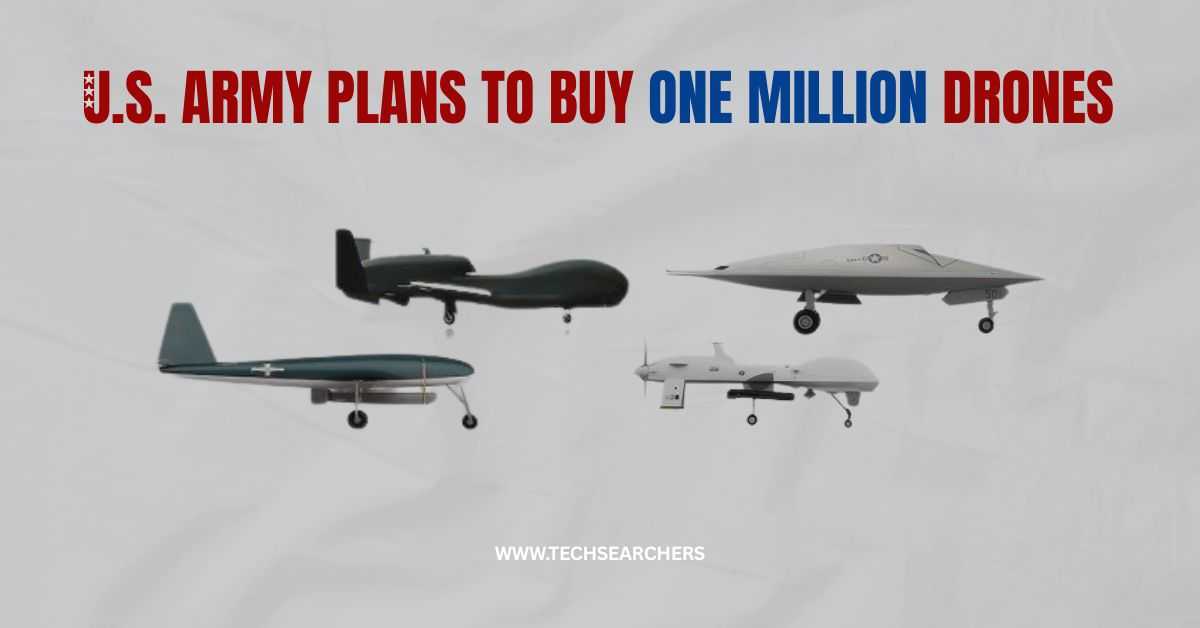
The U.S. Army’s plan to acquire one million drones marks a historic shift in modern warfare and unmanned systems. Army Chief of Staff General James McConville announced the initiative at the Association of the United States Army (AUSA) conference in Washington, D.C., emphasizing the urgent need to modernize the force amid evolving global threats. Currently purchasing around 50,000 drones annually, the Army aims to scale up to one million drones over the next two to three years.
This massive expansion underscores the strategic importance of drones for surveillance, battlefield intelligence, and rapid-response operations. By boosting domestic production and partnering with commercial manufacturers, the Army seeks to integrate unmanned systems into operational tactics more effectively, applying lessons from conflicts such as the war in Ukraine. Analysts say this move will significantly enhance U.S. military readiness and technological edge.
Main Update
In a recent interview on November 7, 2025, Secretary Driscoll confirmed the U.S. Army’s ambitious plan to acquire at least one million drones over the next two to three years. While the Army currently purchases around 50,000 drones each year, Driscoll described the expansion as a significant undertaking, one that the service is confident it has the capacity to execute successfully.
Key Features of the Plan
- Rapid Expansion: Acquisition targets jump from 50,000 drones per year to over one million units in two to three years.
- Domestic Production: Emphasis on U.S.-based manufacturing for drone components such as batteries, sensors, and circuits.
- Commercial Partnerships: Collaborations with civilian drone makers to accelerate output and innovate production processes.
- Operational Integration: Developing tactics for mass drone deployment while creating counter-drone systems (C-UAS) to maintain battlefield advantage.
- Legislative Support: Lawmakers are introducing initiatives to establish facilities, like in Texas, capable of producing up to a million drones annually, while overall production will be distributed across multiple sites.
Industrial and Tactical Implications
The plan is not just about acquiring hardware but ensuring drones are fully integrated into operational tactics. The Army is developing strategies for swarm operations and countering enemy unmanned aerial systems (C-UAS).
Production will be spread across multiple facilities in the U.S., with legislation supporting a Texas facility capable of producing up to one million drones per year.
To give readers a clear picture of the scale and strategy, here’s a comparison of current drone acquisition versus the planned ramp-up:
U.S. Army Drone Acquisition: Current vs. Planned
| Category | Current Status | Planned Ramp-Up | Notes |
| Annual Drone Acquisition | ≈50,000 drones/year | 1,000,000 drones over 2–3 years | Twenty-fold increase |
| Production Approach | Primarily defense contractors | Domestic & commercial partnerships | Includes UAV makers serving civilian markets |
| Industrial Capacity | Limited for mass production | Distributed across multiple U.S. facilities | Texas facility capable of 1M/year proposed |
| Tactical Integration | Ad hoc use in units | Fully integrated into operational tactics | Focus on swarm operations & C-UAS (Counter-UAS) |
| Drone Types | Standard surveillance UAVs | Mix of tactical, commercial-style, and expendable drones | Designed for mass deployment & battlefield scalability |
| Supply Chain | Traditional defense supply chains | Expanded to include commercial UAV suppliers | Includes batteries, sensors, and circuits |
| Lessons Applied | Based on conventional warfare | Influenced by Ukraine conflict | Emphasizes inexpensive mass-produced drones |
Economic and Strategic Impact
This major drone acquisition plan is expected to boost U.S. industrial capacity, generate skilled jobs, and position the military to leverage advanced unmanned systems on the battlefield. It also reflects a shift in defense strategy, moving toward mass-produced, agile technologies over solely high-cost, niche systems.
By fostering commercial partnerships and encouraging domestic production, the Army aims to maintain technological superiority while reducing dependence on traditional defense contractors. Observers note that the lessons from Ukraine will shape tactics, ensuring rapid deployment, scalability, and flexibility in modern conflicts.
Conclusion
The US Army plans to buy 1 million drones highlights a transformative moment in military strategy and technological modernization. General McConville’s emphasis on accelerating domestic drone production and integrating unmanned systems into operations reflects the Army’s focus on readiness, rapid response, and battlefield superiority. This large-scale drone initiative not only strengthens the U.S. military’s intelligence, surveillance, and reconnaissance capabilities but also ensures a strategic edge over global competitors.
As unmanned systems become central to modern warfare, the Army’s move signals how technology and innovation are reshaping defense priorities. For policymakers, defense analysts, and technology enthusiasts, understanding this acquisition provides insight into the future of military operations and America’s commitment to maintaining a cutting-edge, agile, and technologically advanced force.
Frequently Asked Questions
How will the drones be produced?
Production will involve both domestic facilities and commercial partnerships with companies that manufacture civilian drones, ensuring industrial scalability and innovation.
What types of drones will the Army acquire?
The acquisition includes a mix of surveillance, tactical, and expendable drones, enabling mass deployment and flexible battlefield applications.
How will this impact U.S. defense strategy?
The program emphasizes swarm tactics, counter-drone systems, and rapid operational integration, reflecting a shift toward agile, mass-produced technologies in modern warfare
Why is the U.S. Army planning to buy one million drones?
The Army aims to expand its drone capabilities rapidly, drawing lessons from Ukraine, where affordable mass-produced drones played a crucial role in combat.
