
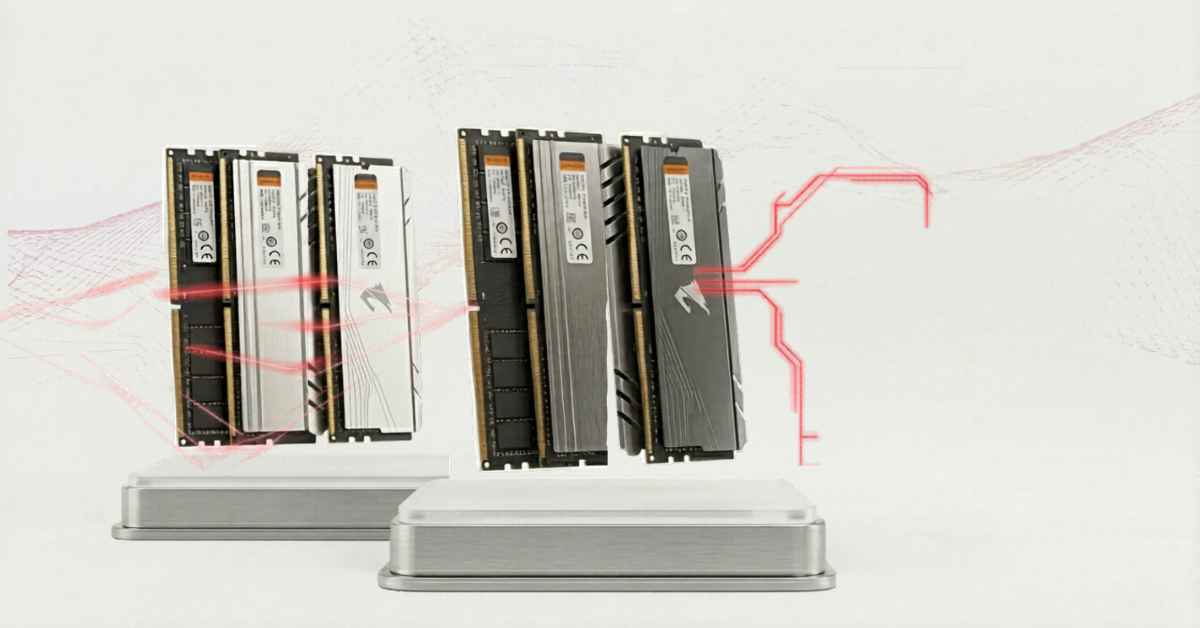
Something unusual is happening in the PC memory market in 2026, the older, slower DDR4 RAM now costs more than the newer, faster DDR5. This is not a glitch or a temporary sale. It is a permanent market shift driven by one powerful force: artificial intelligence.
Global AI data centers are consuming memory at a record pace. To meet that demand, the world’s biggest memory makers — Samsung, SK Hynix, and Micron, have been quietly shutting down DDR4 production lines and repurposing them for High Bandwidth Memory (HBM), the specialized chip powering AI accelerators like NVIDIA’s H100 and B200 GPUs.
The result? DDR4 is becoming scarce. Scarce means expensive. Meanwhile, DDR5 factories are running at full speed, pushing prices down.
For anyone building a PC, upgrading a gaming rig, or advising clients on hardware purchases in 2026, this price flip changes everything you thought you knew about buying RAM.
What Is Actually Happening to PC Memory Prices in 2026?
Until recently, DDR4 was the budget-friendly choice. It was cheap, widely available, and perfectly adequate for everyday computing. DDR5 carried a premium price tag because it was newer and faster.
That relationship has now reversed completely.
By early 2026, DDR4 prices have climbed significantly above DDR5 prices on a cost-per-gigabyte basis. A standard 16GB DDR4 kit in many markets now costs more than a comparable 16GB DDR5 kit. A 32GB DDR4 kit is harder to find and commands a noticeable premium over equivalent DDR5 options.
This is not driven by DDR5 getting cheaper overnight. It is driven by DDR4 supply collapsing while DDR5 production continues to scale up.
The Root Cause: AI Is Eating the Memory Supply Chain
Chen Libai, Chairman of ADATA — one of the largest independent memory manufacturers based in Taipei, Taiwan — stated publicly that AI data center demand is “gobbling up” global DRAM production capacity.
Here is why that matters so directly for your PC memory purchase:
HBM (High Bandwidth Memory), the type of RAM used inside AI chips, requires roughly four times more semiconductor wafer capacity to produce than standard DDR5. It requires even more relative to DDR4. When Samsung and SK Hynix shift a production line to HBM, the loss to consumer DDR4 supply is enormous.
AI infrastructure investment is not slowing down. Governments, hyperscalers like Microsoft, Google, Amazon, and Meta, and enterprise data centers worldwide are all competing for HBM supply. Memory manufacturers follow the money. The money is in AI, not in your desktop RAM upgrade.
DDR4 is the first casualty.
DDR4 vs DDR5 in 2026: A Full Comparison
| Feature | DDR4 | DDR5 |
|---|---|---|
| Speed | Up to 3200 MT/s | 4800 MT/s to 8400+ MT/s |
| Max Capacity Per Module | 32GB | 64GB and growing |
| Operating Voltage | 1.2V | 1.1V |
| Error Correction | Only on expensive ECC kits | On-die ECC on all modules |
| 2026 Price (per GB) | Higher and rising | Lower and stable |
| Platform Support | Intel LGA 1700 and older, AMD AM4 | Intel LGA 1851, AMD AM5 |
| Future Availability | Declining rapidly | Expanding production |
The data tells a clear story. DDR5 is faster, more power efficient, more reliable, more available, and cheaper per gigabyte right now in 2026. The only reason to buy DDR4 today is if you are upgrading an existing older system that physically cannot accept DDR5.
DDR5 Technical Advantages: Why It Wins Beyond Price
Speed and Bandwidth
DDR5 starts at 4800 MT/s and enthusiast kits now reach 8400 MT/s and beyond with XMP or EXPO profiles. DDR4 topped out at 3200 MT/s under normal conditions. This difference matters enormously for CPU performance on modern platforms. Intel’s Core Ultra 200 series (LGA 1851) and AMD’s Ryzen 9000 series (AM5) are both designed to reach their full potential only with DDR5.
On-Die Error Correcting Code
Every single DDR5 module — including the budget ones — includes on-die ECC built into the memory chip itself. This means the module continuously checks and corrects small data errors before they cause crashes or corruptions. DDR4 only offered ECC in expensive, server-targeted configurations. For everyday users, this makes DDR5 noticeably more stable, especially when running at higher frequencies or for long gaming or workstation sessions.
Higher Density Modules
DDR5 architecture supports much higher chip density. 32GB single sticks are now common and affordable. 48GB and 64GB consumer modules are widely available. This is important for content creators, video editors, programmers, and anyone running virtual machines or large applications. DDR4 struggled to scale beyond 32GB per stick in practical consumer form.
Lower Power Consumption
DDR5 runs at 1.1V versus DDR4’s 1.2V. This is a small number that adds up meaningfully over time, especially in systems running 24/7 or in laptops where battery life matters.
What Should You Do Right Now?
If You Are Building a New PC
Choose a DDR5 platform without hesitation. AMD AM5 and Intel LGA 1851 both offer strong CPU options across all price tiers. DDR5 memory is now the better value, the better performer, and the more future-proof choice. There is no longer a cost-based argument for choosing a new DDR4 platform.
If You Need to Upgrade an Existing DDR4 System
Buy your DDR4 memory immediately. Do not wait. Every projection from ADATA, Samsung, and industry analysts points to continued DDR4 price increases through 2026 and into 2027 as production lines are permanently decommissioned. The window to buy at current prices is narrowing fast.
If You Are Advising Others on PC Purchases
Steer any new build toward DDR5. Flag the DDR4 price situation clearly for anyone budgeting for upgrades on older platforms. The market data is unambiguous.
Main Update: AI Demand Decimates DDR4 PC Memory Supply
Chen Libai, from ADATA’s Taipei headquarters, revealed that AI data center demand is “gobbling up” DRAM production. Samsung and SK Hynix, the industry giants, are prioritizing HBM, crucial for powering AI accelerators, over commodity DDR4 and even some DDR5. HBM production requires about four times the wafer capacity of standard DDR5.
This major shift has rendered DDR4 increasingly rare and costly, and DDR5 supply is beginning to feel the pressure. PC memory buyers and builders now need to act fast to avoid rising prices and limited choices in the coming year.
Impact & Features: Why DDR5 Is the Future of PC Memory
Advanced technology cements DDR5’s position as the new standard for PC memory:
- Speed & Bandwidth: DDR5 modules start at 4800 MT/s and scale past 8000 MT/s, easily doubling DDR4’s ceiling of 3200 MT/s. This allows top-tier CPUs from Intel (LGA 1851) and AMD (AM5) to reach their full performance potential.
- Capacity & Density: DDR5 architecture supports higher-density chips, with 32GB kits becoming common and larger consumer modules (48GB, 64GB) now widely available and more affordable.
- Power Efficiency: Running at just 1.1V versus DDR4’s 1.2V, DDR5 reduces system power consumption, helping keep systems cooler and quieter.
- On-Die ECC: Unlike traditional ECC, which requires expensive setups, DDR5 incorporates on-die ECC by default. This feature self-corrects data errors internally for increased stability, especially at higher frequencies.
The Bigger Picture: AI Is Restructuring the Entire Memory Industry
The DDR4 price flip is not an isolated event. It is one visible symptom of a broader restructuring happening across the semiconductor and memory industry because of AI.
HBM demand from AI accelerators has created a new tier in the memory market that sits above everything else in terms of pricing, priority, and manufacturer attention. Standard DRAM — both DDR4 and DDR5 — exists in AI’s shadow now.
This has real consequences beyond just RAM prices. It is affecting graphics card memory, server DRAM availability, and the pace at which new consumer memory technologies like LPDDR6 and DDR6 are developed and released.
For PC builders, the lesson is clear: the memory market no longer moves purely on consumer PC demand cycles. It moves on AI infrastructure investment cycles. And those cycles are currently pointing in one direction — away from DDR4 and toward higher-bandwidth, AI-optimized memory.
Conclusion
The PC memory market has undergone a real and lasting shift. DDR4, the budget staple that defined a decade of PC builds, is now a premium legacy product with a shrinking supply and a rising price tag. DDR5, once the expensive newcomer, has matured into the affordable, high-performance standard.
AI caused this. The insatiable demand for High Bandwidth Memory to power data centers and AI accelerators has permanently redirected the priorities of the companies that make your RAM.
For 2026 and beyond, the guidance is simple: build on DDR5, upgrade DDR4 systems now if you need to, and understand that the memory market you knew three years ago no longer exists.
Frequently Asked Questions (FAQs)
Why is DDR4 more expensive than DDR5 in 2026?
DDR4 production has been heavily cut back as manufacturers redirect factory capacity to High Bandwidth Memory for AI data centers. Less supply with steady demand means higher prices. DDR5 production has scaled up simultaneously, lowering its cost per gigabyte below DDR4.
Is DDR5 worth it for gaming in 2026?
Yes. DDR5 now offers better price-per-gigabyte than DDR4 and delivers higher bandwidth that benefits modern CPUs on AM5 and LGA 1851 platforms. For any new gaming build, DDR5 is the correct choice both on performance and value grounds.
Should I upgrade from DDR4 to DDR5?
If your current system runs fine, a memory-only upgrade to DDR5 is not possible since the two are not cross-compatible. DDR5 requires a new motherboard and compatible CPU. If you are already planning a CPU and motherboard upgrade, choosing a DDR5 platform is strongly recommended.
How long will DDR4 be available?
Production will continue to wind down through 2026. DDR4 will remain available as a legacy product but at premium and increasingly unpredictable prices. Availability will become patchy in major retail channels by 2027.
What memory standard comes after DDR5?
DDR6 is in development and expected to enter the consumer market in 2027 or 2028. LPDDR6 for mobile platforms is also in progress. For now, DDR5 is the current and forward-looking standard for desktop and laptop builds.
