
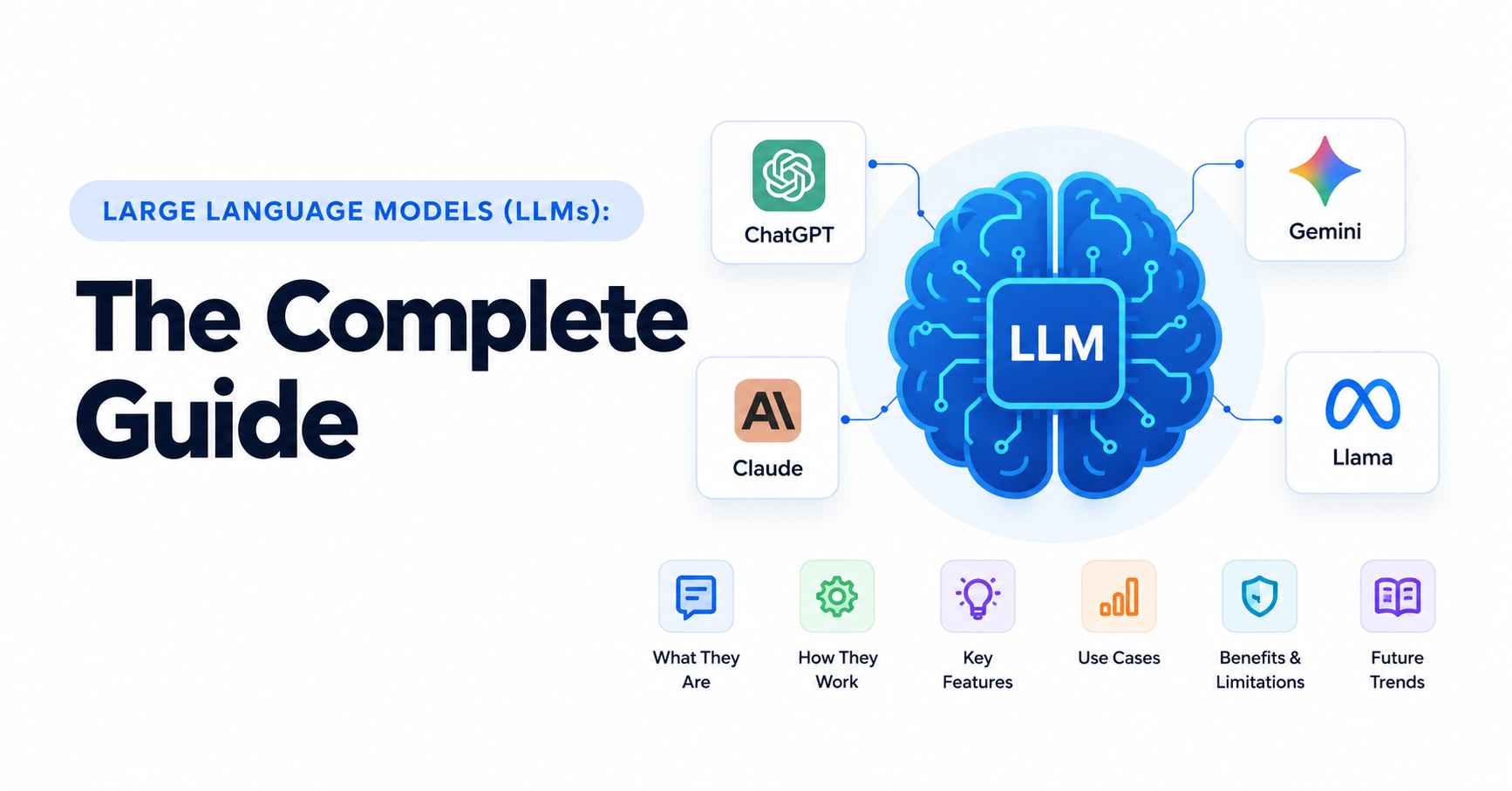
A large language model (LLM) is a deep learning model trained on massive text datasets to understand, generate, and manipulate human language. LLMs learn statistical patterns of language by predicting the next token in a sequence, enabling them to answer questions, summarize documents, write code, translate languages, and hold conversations.
You interact with LLMs daily through a rapidly growing ecosystem of AI chatbots and assistants. Some of the most famous and useful platforms include ChatGPT, Claude, Gemini, Llama, Microsoft Copilot, Perplexity, Mistral (Le Chat), DeepSeek, Grok, Pi, Poe, Character.AI, You.com, Jasper, and Copy.ai. Whether used for enterprise search, creative writing, coding, or everyday Q&A, these chatbots are all powered by the underlying LLM architectures discussed in this guide.
Quick definition (featured snippet): An LLM is a neural network with billions of parameters, typically built on the transformer architecture, trained on large text corpora using self-supervised learning to predict and generate language.
Key distinction: LLMs are a subset of foundation models (large models adaptable to many tasks), which are a subset of deep learning, which is a subset of machine learning, which sits within artificial intelligence (AI). Generative AI is the broader category of models that create content; LLMs are its text-focused core. NLP (natural language processing) is the field; LLMs are a modern technique within it.
How Do LLMs Work?
The Core Mechanism: Next-Token Prediction
LLMs are trained to predict the most probable next token—a word, subword, or character fragment—given preceding tokens. Repeated prediction generates coherent text. This simple objective, scaled up, produces emergent capabilities like reasoning, translation, and code generation.
Analogy: Think of an LLM as an extraordinarily well-read autocomplete. It doesn’t “know” facts the way a database does; it models which sequences of words are probable given its training.
Tokens and Tokenization
Text is split into tokens (e.g., “unbelievable” → “un” + “believ” + “able”). Tokens are the fundamental unit of processing, cost, and context limits. A rough rule: 1 token ≈ 0.75 English words.
The Transformer Architecture
Introduced in the 2017 paper “Attention Is All You Need,” the transformer replaced recurrent networks. Its key innovation, self-attention, lets each token weigh the relevance of every other token in context—capturing long-range relationships efficiently and enabling parallel training.
Core components:
- Embeddings: Convert tokens into vectors.
- Self-attention layers: Model relationships between tokens.
- Feed-forward layers: Transform representations.
- Positional encoding: Preserve word order.
- Decoder stack (for generative LLMs): Produces output tokens autoregressively.
Context Window
The context window is the maximum number of tokens a model can consider at once (input + output). Larger windows enable long-document analysis and extended conversations but increase memory and compute costs.
How Are LLMs Trained?
Training typically occurs in stages:
- Pre-training (self-supervised): The model learns language patterns from trillions of tokens of web text, books, and code by predicting masked or next tokens. This is the most compute-intensive stage.
- Supervised fine-tuning (SFT): The model is trained on curated instruction–response pairs to follow directions.
- Alignment (RLHF/DPO): Reinforcement Learning from Human Feedback (RLHF) or Direct Preference Optimization (DPO) aligns outputs with human preferences for helpfulness, harmlessness, and honesty.
- Continued pre-training / domain adaptation: Optional specialization for fields like medicine, law, or code.
Parameters and Scale
Parameters are learned weights. Model sizes range from small (millions) to very large (hundreds of billions+). Scaling laws show performance improves predictably with more parameters, data, and compute—though with diminishing returns and rising costs.
LLMs vs. Related Concepts
| Concept | Definition | Relationship to LLMs |
|---|---|---|
| AI | Broad field of intelligent machines | LLMs are one AI technology |
| Machine Learning | Systems learning from data | LLMs are ML models |
| Deep Learning | ML using multi-layer neural networks | LLMs are deep neural networks |
| NLP | Field of language–computer interaction | LLMs are an NLP technique |
| Foundation Models | Large models adaptable to many tasks | LLMs are text-based foundation models |
| Generative AI | AI that creates content | LLMs generate text; also images/audio models |
| AI Agents | Systems that plan and act autonomously | Often built on LLMs as reasoning engines |
What Can LLMs Do? Key Applications
- Conversational AI & chatbots: Customer support, assistants.
- Content generation: Drafting, editing, summarizing, marketing copy.
- Code generation & review: Autocomplete, debugging, documentation (e.g., coding assistants).
- Search & retrieval: Answer synthesis, semantic search, RAG (Retrieval-Augmented Generation).
- Translation & transcription: Multilingual communication.
- Data extraction & classification: Structured output from unstructured text.
- Education & tutoring: Explanations, practice, feedback.
- Analysis & reasoning: Summarizing reports, extracting insights.
- Healthcare, legal, finance: Domain-specific drafting and assistance (with oversight).
RAG and Fine-Tuning
- Fine-tuning: Further training a model on task-specific data to specialize behavior.
- RAG: Retrieves relevant documents at inference time and supplies them to the model, improving factuality and freshness without retraining—reducing hallucinations and enabling citations.
Strengths of LLMs
- Versatility: One model handles many tasks without task-specific engineering.
- Natural interaction: Plain-language interfaces lower barriers.
- Speed & scale: Rapid generation at low marginal cost.
- Few-shot learning: Performs new tasks from a few examples in the prompt.
- Multilingual & multimodal trends: Growing support for languages and text-plus-image/audio inputs.
Limitations and Risks
- Hallucinations: Confident but false outputs; models optimize plausibility, not truth.
- Bias: Inherited from training data; can produce stereotyped or unfair outputs.
- Knowledge cutoff: Training data is static; models lack recent events unless augmented (e.g., RAG, tools).
- Context limits: Long inputs may be truncated or degrade performance.
- Reasoning limits: Struggles with multi-step logic, math, and precise computation without tools.
- Privacy & security: Risk of leaking sensitive data; prompt injection and jailbreaks; data memorization concerns.
- Cost & energy: Training and inference are computationally expensive and energy-intensive.
- Explainability: Internal reasoning is opaque; outputs are hard to audit.
- Misuse: Disinformation, plagiarism, fraud, and impersonation risks.
Mitigations: Human review, RAG with verified sources, guardrails, evaluation benchmarks, red-teaming, privacy-preserving training, and responsible-use policies.
Prompting and Inference
- Prompt engineering: Designing inputs (instructions, context, examples) to elicit desired outputs. Techniques include zero-shot, few-shot, chain-of-thought, and role prompting.
- Inference: The process of generating outputs from a trained model. Parameters like temperature (randomness) and top-p (nucleus sampling) control output diversity.
- Tools & function calling: LLMs can invoke external APIs, calculators, or databases for accuracy.
- Evaluation: Measured via benchmarks (reasoning, coding, safety), human ratings, and task-specific metrics. No single benchmark captures all capabilities.
Emerging Developments
- Multimodal LLMs: Native handling of text, images, audio, and video.
- Long-context models: Million-token windows for book-scale analysis.
- Smaller, efficient models: Distillation and quantization for on-device and cost-sensitive use.
- Agentic systems: LLMs planning, using tools, and executing multi-step tasks.
- Mixture-of-Experts (MoE): Activating subsets of parameters for efficiency at scale.
- Reasoning-focused models: Extended deliberation for complex problems.
- Open-weight models: Broader access, customization, and community innovation.
- Regulation & governance: Evolving frameworks (e.g., EU AI Act) shaping transparency, safety, and accountability.
Top 15 AI Chatbots & LLM Comparison
| Chatbot / Platform | Underlying Models | Best Part (Key Advantage) | Primary Use Case |
|---|---|---|---|
| ChatGPT | GPT-4o, GPT-4, o1 | The All-Rounder: Unmatched ecosystem… | General productivity… |
| Claude | Claude 3.5 Sonnet, 3 Opus | Context & Nuance: Exceptional at… | Long-document analysis… |
| Gemini | Gemini 1.5 Pro/Flash | Native Multimodality: Deep integration… | Google ecosystem users… |
| Microsoft Copilot | GPT-4, GPT-4o | Enterprise Integration: Seamlessly… | Corporate workflows… |
| Llama | Llama 3 (8B, 70B) | Open-Weight Accessibility: Highly… | Developers, privacy… |
| Perplexity AI | GPT-4o, Claude 3, Sonar | Real-Time Search: Provides cited… | Research, fact-checking… |
| Mistral | Mistral Large 2, Mixtral | European & Open-Source Power: Highly… | Multilingual tasks… |
| DeepSeek | DeepSeek-V2, DeepSeek Coder | Cost & Coding Efficiency: Extremely… | Coding assistance… |
| Grok | Grok-1, Grok-1.5 | Real-Time X Data: Unfiltered… | Trend analysis… |
| Pi | Inflection-2.5 | Emotional Intelligence: Designed for… | Personal advice… |
| Poe | GPT-4, Claude 3, Gemini, etc. | Aggregator Hub: Quora’s platform… | Comparing models… |
| Character.AI | Proprietary (Roleplay-tuned) | Immersive Personas: Best-in-class… | Entertainment… |
| You.com | GPT-4, Claude, Gemini | Custom Search Agents: Lets users… | Deep web research… |
| Jasper | GPT-4, Proprietary | Marketing Workflows: Purpose-built… | Marketing copy… |
| Copy.ai | GPT-4, Claude, Proprietary | GTM Automation: Focuses on sales… | Sales outreach… |
Conclusion
Large language models are transformer-based neural networks trained on vast text to predict and generate language, powering applications from chatbots and coding assistants to search and analysis. They offer remarkable versatility but carry real limitations—hallucinations, bias, cost, and security risks—that demand human oversight and responsible deployment. Understanding their mechanisms, distinctions from adjacent concepts, and evolving capabilities is essential for anyone navigating the AI era. As multimodal, agentic, and efficient models advance, LLMs will remain a foundational technology—best used with clear-eyed awareness of both their power and their boundaries.
Frequently Asked Questions (FAQs)
What does LLM stand for?
Large Language Model—a deep learning model trained on large text datasets to understand and generate language.
How do LLMs differ from chatbots?
A chatbot is an application; an LLM is the underlying model. Chatbots often combine LLMs with retrieval, tools, and safety layers.
Are LLMs conscious or truly intelligent?
No. They model statistical language patterns and lack understanding, intent, or consciousness. Their outputs can appear intelligent without genuine comprehension.
Can LLMs access the internet?
Not natively. They need tools, plugins, or RAG systems to retrieve current information.
What is a hallucination?
A plausible but incorrect or fabricated output, caused by next-token prediction optimizing fluency over factual accuracy.
What is a context window?
The maximum number of tokens an LLM can process at once, including input and output.
What is fine-tuning vs. RAG?
Fine-tuning adapts model weights to a task or domain. RAG supplies external retrieved context at inference without changing weights. They’re complementary.
Are LLMs private and secure?
Depends on deployment. Enterprise and on-premises options improve control; users must still avoid sharing sensitive data and guard against prompt injection.
What’s the difference between an LLM and generative AI?
Generative AI is the broad category (text, images, audio, video); LLMs are the text-focused subset.
Will LLMs replace jobs?
They automate tasks, not entire roles uniformly. Impact varies by industry; augmentation and new roles are common outcomes, alongside displacement risks requiring adaptation.
