
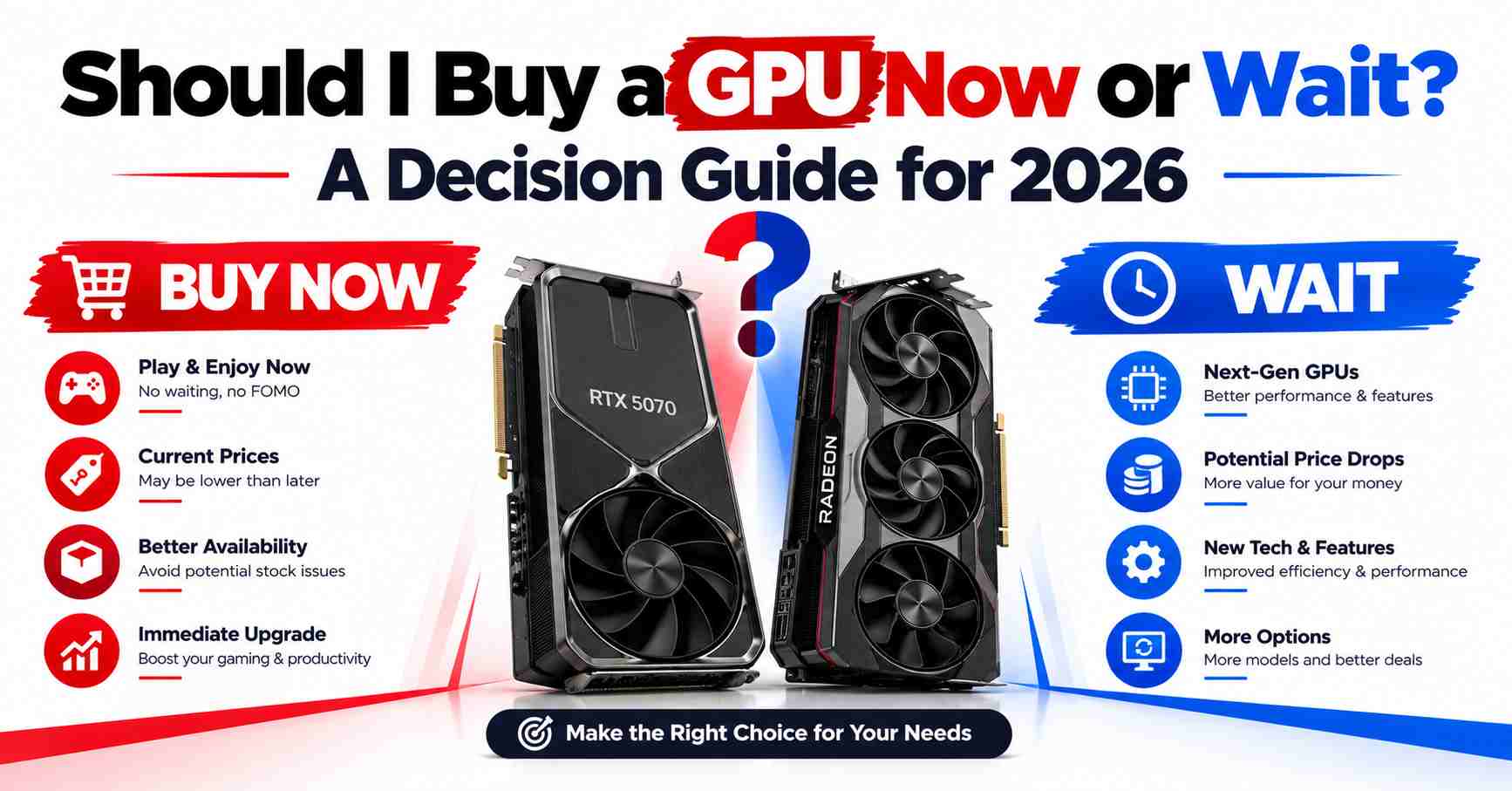
Quick Answer: Buy a GPU now if your current card has failed, can’t run your games at playable frame rates, or you can find a model at or near MSRP on a trusted listing, such as one marked “Ships from and sold by Amazon” (check current GPU prices). Wait if your card still performs well, you’re shopping the high end where markups are steepest, or your build can realistically slip. Through 2026, waiting has not lowered prices, and no next-generation launch date has been confirmed.
If you’re asking “should I buy a GPU now or wait,” you’re not imagining the problem. Several RTX 50 series cards, including the RTX 5080 and RTX 5070 Ti, sell well above their suggested retail prices, and every rumor promises relief later. This guide separates confirmed facts from single-source data and unconfirmed reports, then gives you a framework based on your resolution, budget, and current card.
What is happening with GPU prices in 2026?
First, two terms. MSRP is the manufacturer’s suggested retail price — the launch price a maker announces. Street price is what stores actually charge. In a normal year, the two are close. In 2026, for current cards, they often are not.
Confirmed, single-source, and reported — kept separate
Single-source data (directional, not settled fact): The first edition of the SmartValueLab Tech Price Index, with data dated October 13, 2026, tracked Amazon prices and reported current-generation cards — RTX 50 and RX 9000 — up a median 32.7% over about 90 days, with all 12 tracked cards rising. In that same index, older cards were flat at 0.0%, CPUs were flat at 0.0%, and retail RAM kits were flat over a shorter 60-day window. That is one source, one retailer set, and 12 current cards, so treat it as a direction signal, not a market-wide measurement.
Reported, unconfirmed (Checked: October 23, 2026 — VideoCardz, reporting Board Channels): ASUS and Gigabyte raised RTX 5080 wholesale prices in China in October 2026 (about +$150 and +$180 per card at distributor level), and the same report claims the 16GB model may be discontinued ahead of a 24GB replacement. NVIDIA has confirmed none of this, and China wholesale moves are not US retail prices — but if they hold, they point the same way as the index above: up, not down.
Confirmed context: Memory costs underneath graphics cards are still rising. TrendForce forecast conventional DRAM contract prices — the prices big buyers negotiate with chipmakers — to rise 10% to 15% quarter over quarter in Q4 2026, with no relief forecast before late 2027 in the outlook summarized in our RAM article. Contract prices are not shelf prices, but graphics cards use memory chips, so sustained rises make quick, large GPU price cuts harder. That background helps explain GPU prices 2026, without proving any one store’s price.
The plain takeaway: Through 2026, graphics card prices for current models rose, not fell. Waiting so far this year has not paid off. That is a statement about the past months, not a promise about next year.
What is officially coming — and what is only rumored?
This is where honesty matters most, because a launch date you can plan around needs an official announcement.
Confirmed facts
As of October 23, 2026, neither NVIDIA nor AMD has officially announced a next-generation desktop graphics card lineup with a confirmed launch date. NVIDIA’s official newsroom announcement for the current generation is its GeForce RTX 50 Series launch, and AMD has not confirmed a name, specifications, pricing, or release schedule for a successor to its RX 9000 series. In short: the next generation has no confirmed date from either maker.
Unconfirmed reports — labeled, not advice
Unconfirmed report: NVIDIA RTX 50 Super series. Leaks have long pointed to an RTX 50 Super refresh of NVIDIA’s Blackwell lineup: the RTX 5080 Super and RTX 5070 Ti Super with a rumored 24 GB of VRAM each, and the RTX 5070 Super with a rumored 18 GB. VRAM (video memory) is the memory on the card itself. The lineup was reportedly built around a 50% VRAM increase. NVIDIA has never announced these cards, a teaser, or a date, and the series did not appear at CES 2026. Reports conflict on what happens next. Some say the refresh was delayed indefinitely, citing rising VRAM costs, memory shortages, and AI-sector demand. Others say it may be cancelled outright. The shortage centers on 3 GB GDDR7 memory chips. VideoCardz reported that partners hold the GPU chips but lack affordable 3 GB modules, which NVIDIA may be redirecting to AI products like the RTX Pro 6000 Blackwell. One report claims the knock-on effect could push the RTX 60 series, NVIDIA’s next generation, as late as 2028. Because the reports disagree and none is official, do not base a purchase on them.
Unconfirmed report: AMD RDNA 5 (next-gen Radeon). AMD has confirmed that RDNA 5 exists and will power next-generation console chips, but it has not announced a desktop Radeon launch date or lineup. Leaker Kepler_L2 says an RDNA 5 reveal is unlikely before Computex 2027 (June 1-4), and a later 2027 reveal is considered more likely. That would leave the current RDNA 4 Radeon RX 9000 series, including the Radeon RX 9070 XT, on shelves for over two years. The claim concerns a reveal, not store availability, and AMD has not confirmed any date. Treat it as a leak, not an AMD schedule.
Intel. Intel’s rumored Arc B770 was also absent from CES 2026, so no confirmed third option is coming soon either.
Bottom line: A rumored product with no confirmed date, price, or specifications cannot be the best time to buy a graphics card. Across NVIDIA (RTX 5080, RTX 5070 Ti, RTX 5070), AMD (Radeon RX 9070 XT), and Intel (Arc), the shelf lineup you can buy today is the only one confirmed. Stay flexible about timing, but don’t go without a working PC while you wait.
Should I buy a GPU now or wait? The decision framework
Forget timing the market perfectly. Match the choice to your card, your resolution, and the price in front of you.
Buy now if…
- Your current card is dead or cannot run what you play
- You found a card at or near its official MSRP
- Your target resolution is well served by current midrange cards
- A sourced sale brings a card to a fair price
Wait if…
- Your current card still runs your games acceptably
- You are shopping the high end where markups are worst
- You can hold out for late-November sales season or a restock cycle
- Your whole build can slip
The late-November sales season includes Black Friday on November 27, 2026. A sale can help if it brings a specific card near MSRP, but a sale date is not a guarantee that GPU prices will drop — check the actual street price, not the size of the claimed discount.
Has waiting ever paid off?
Yes, in a past cycle — and that difference matters. In 2022, after cryptocurrency mining demand collapsed, graphics card prices fell sharply, with reporting at the time showing some used prices down by nearly half in a few months and new cards selling below MSRP by mid-2022. Patience paid then because a major source of demand disappeared. No source is reporting an equivalent demand collapse in October 2026; instead, memory supply is being pulled toward AI data centers. Past cycles show prices can fall. They do not tell you they will fall on a schedule.
What does waiting actually cost?
Waiting is not free, even when it saves money later.
If your card has died, waiting means no PC for gaming, and possibly no PC at all if you have no backup graphics. That is not a timing choice; it is a repair.
If your card struggles, waiting means months at low settings, lower resolution, or skipping new games you bought the PC to play. Upscaling tools can help — they render at a lower resolution and rebuild the image — but they cannot add VRAM or fix a card that is far below a game’s needs.
Waiting also carries price risk in the other direction. Through 2026, the risk that showed up was higher prices, not lower ones. Anyone who waited expecting a routine drop paid more, or is still waiting.
What can waiting gain?
Waiting can still be the right call, for real reasons.
You may get a card closer to MSRP during a restock or sale, instead of paying the worst markup on a high-end model. You may learn whether a rumored refresh becomes official, with real prices and dates. And if your current card is fine, waiting costs you nothing in performance — your games already run acceptably, so every month you hold out is a month you did not overpay.
The gain is largest at the high end, where the single-source index and store listings suggest markups are worst, and smallest when a sensibly priced midrange card already does exactly what you need today.
Advice by situation
Your card died
Buy now. Choose the card that fits your resolution and power supply at the best street price you can find from a reputable seller, and do not pay a panic markup for a higher tier you do not need. A working PC today beats a rumored card with no date.
Your card struggles at your resolution
Lower settings and use upscaling first, for a week or two. If the games you play most still feel bad, buy now — your problem is present, not future. Pick VRAM for the resolution you actually use, and avoid a small step up that you will outgrow in months.
You are a competitive player
Frames and consistency matter more than maximum settings. If your card holds the frame rate your monitor needs in your main game, wait. If it drops frames in matches, buy the midrange card that fixes that now — competitive play does not benefit from a future flagship.
You are a 4K enthusiast
You face the worst markups and the most tempting rumors. If you can still enjoy your library at settings you accept, waiting for a sale, a restock, or official news is reasonable. If 4K is the whole point of your PC and current cards at fair prices can deliver it, buy at or near MSRP only — do not chase the highest street price.
You are a budget buyer
Do not stretch to a current card at a heavy markup. Consider last-generation cards, which were flat in the single-source index, or the used market below. Set a maximum price based on MSRP, check more than one store, and be willing to walk away from a bad listing. On a tight budget, paying a peak markup hurts the rest of the build.
Is the used market a middle path?
A used previous-generation card can bridge the gap: you get a working, faster PC now without paying today’s new-card markup, and you can reassess when official news arrives.
Use cautions, because used cards rarely come with a full warranty:
- Buy from a seller or platform that accepts returns, and test the card as soon as it arrives.
- Ask what the card was used for, and avoid listings that hide the exact model, memory size, or condition.
- Check temperatures, fan noise, and stability in your own games during the return window.
- Compare the used price with new last-generation prices — if the gap is small, new with a warranty is usually safer.
- Confirm your power supply has the wattage and connectors the card needs before you pay.
A used card is a compromise, not a bargain by default. Price it like one.
Mistakes to avoid
- Panic-buying at peak markups. A card far above MSRP because a listing says stock is vanishing is the most expensive way to buy. Compare stores, compare tiers, and remember midrange cards were the steadier part of the market.
- Waiting for a rumored product with no date. The RTX 50 Super series is unconfirmed. So is AMD’s next generation. Waiting for a product that may be delayed, changed, or cancelled leaves you planning around nothing.
- Buying a low-VRAM card to “tide over.” A cheap card with too little VRAM for your resolution will struggle in the same games, and you will pay twice. Either buy a card that truly serves your resolution, buy used with enough VRAM, or keep saving.
Conclusion
Should you buy a GPU now or wait in 2026? It depends on your situation, not the calendar. Buy now if your card is dead, can’t run your games, or you find a card at or near MSRP. Wait if your current card still works well and you’re facing the worst high-end markups.
The release outlook explains why waiting is a gamble. The Information reported that Nvidia’s RTX 50 Super lineup has been pushed back to an unspecified date, and RTX 60 could slip to 2028 or later. There is a consistent line of rumors but no public primary source that confirms either delay. On AMD’s side, board partners surveyed appear to agree there will be no next-gen Radeon before 2027, and Intel has left the future of new Arc cards unclear. In other words, no confirmed launch is close enough to plan around.
Match your budget to the right card:
- Budget 1080p: Intel Arc B580 or B570, Nvidia RTX 5060 or 5050, AMD RX 9060 XT 8GB.
- 1440p value: AMD RX 9060 XT 16GB, RX 9070, or RX 9070 XT; Nvidia RTX 5060 Ti 16GB or RTX 5070.
- High-end 1440p and 4K: Nvidia RTX 5070 Ti or RTX 5080, and AMD RX 9070 XT if you don’t need Nvidia-exclusive features. The only affordable gaming GPUs with 16GB of VRAM have been AMD’s RX 9070 XT and RX 9060 XT.
- Flagship: the RTX 5090 launched at $1,999, but street prices are far higher, so it rarely makes sense unless you need it professionally.
Your 3-step decision rule: write down (1) your target resolution and refresh rate, (2) the real problem with your current card, such as low frame rates, VRAM limits, or hardware failure, and (3) the highest price you’ll pay. Then buy only when a listing from Amazon or another reputable retailer meets all three. If none does, keep your current card, track prices with Keepa or CamelCamelCamel, and revisit in a few weeks.
Frequently Asked Questions
Will GPU prices drop in 2027?
No confirmed forecast says graphics card prices will drop in 2027. The related memory outlook, from TrendForce, sees DRAM contract prices rising through Q4 2026 with no relief forecast before late 2027. That does not prove GPU shelf prices will follow the same path. Prices fell in 2022–2023 after demand collapsed, so a fall is possible, just not scheduled or promised.
Is the RTX 50 Super series worth waiting for?
Not as a plan, because it is unconfirmed. NVIDIA has not announced any Super model, date, price, or specifications. Reports conflict, with some suggesting a 2027 delay and others suggesting the refresh was scrapped. If your current card works, you can watch for official news. If you need a card now, buy a confirmed product at a fair street price instead.
How long is too long to wait?
Waiting is too long when it costs you the use of your PC. Set a deadline tied to your situation: a dead card means buy now, a struggling card means buy when settings stops being fun, and a working card lets you wait for the late-November sales season or official launch news. Waiting with no deadline for an unconfirmed product is the mistake, not waiting itself.
Should I buy a GPU now or wait if my card still works?
Wait, in most cases. If your card runs your games acceptably at your resolution, you lose nothing by holding out for a sale, a restock, or a price closer to MSRP. The exception is a genuine fair price today: a card at or near MSRP that fits your needs is worth taking, because through 2026 good prices have been brief, not routine.
Will the late-November sales season lower prices?
It might lower some listings, but no source guarantees it. Black Friday in 2026 is November 27, and retailers run sales around that date. Judge each deal by its final street price against MSRP, not by the discount percentage on the page. In a rising market, a “sale” price can still be well above launch price, so compare before and during the season.
Is a used GPU a safe way to save money?
It can be, with checks. Used cards usually lack a full warranty, so buy where returns are accepted, confirm the exact model and VRAM, and test temperatures and stability in your games right away. Avoid listings with unclear condition or no return option. If a new last-generation card costs only a little more, its warranty may be worth the difference.
