
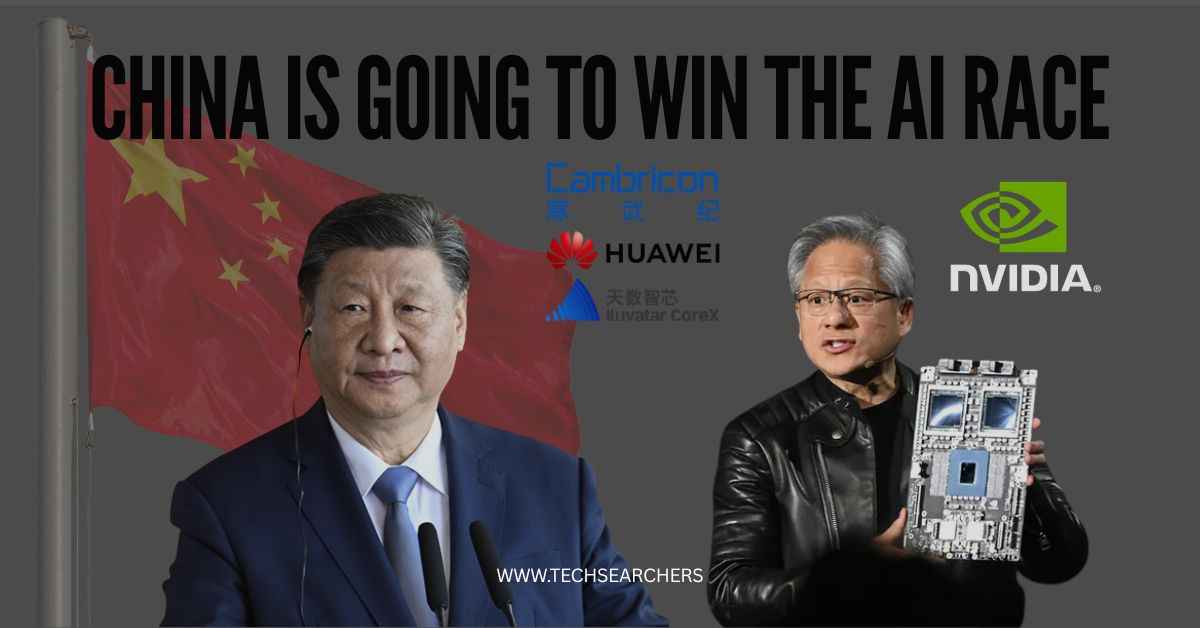
Nvidia CEO Jensen Huang made global headlines after declaring that “China is going to win the AI race” during the Financial Times’ Future of AI Summit on November 5, 2025. While Huang later clarified that the U.S. still holds a slight edge, he warned that restrictive export policies could accelerate China’s AI independence and weaken America’s competitive position.
China’s domestic giants — Huawei (Ascend AI chips), Cambricon Technologies, Iluvatar CoreX, Enflame Technology, and MetaX — are rapidly developing AI accelerators capable of rivaling Nvidia’s GPUs. If China fully replaces U.S. chips with local alternatives, analysts project U.S. companies could lose $7–10 billion annually, with Nvidia absorbing the largest hit.
Huang’s warning underscores a global power shift: China’s growing semiconductor ecosystem is no longer just catching up — it’s poised to challenge Nvidia’s AI supremacy and redefine the future of artificial intelligence innovation.
Key Highlights
- Nvidia CEO Jensen Huang warns that China is going to win the AI race, highlighting competitive pressures.
- U.S. export restrictions limit Nvidia’s ability to sell advanced AI chips like Blackwell in China.
- Huang emphasizes the importance of winning developers globally while maintaining U.S. AI leadership.
- Political scrutiny in Washington intensifies, with former President Donald Trump suggesting Nvidia’s most advanced chips should be reserved for U.S. customers.
Main Update
At the Financial Times’ Future of AI Summit, Huang stated, “China is going to win the AI race,” a comment that immediately drew global attention. Huang warned that excessive regulation in the West, contrasted with China’s energy subsidies and fewer policy barriers, could slow U.S. AI progress.
He highlighted that Nvidia’s global ecosystem, which powers AI development in both countries, is central to maintaining leadership while enabling worldwide innovation.
Jensen Huang’s Clarification on X
Just hours later, Nvidia released a public clarification, softening and contextualizing the CEO’s remarks.
Huang wrote:
“As I have long said, China is nanoseconds behind America in AI.”
“It’s vital that America wins by racing ahead and winning developers worldwide.”
He added that the U.S. should lead by ensuring the global AI ecosystem, including China, is built on American hardware and software stacks. The clarification also echoed Huang’s long-standing position that excluding China harms U.S. influence:
“A policy that causes America to lose half of the world’s AI developers is not beneficial in the long term.”
Policy Tensions: Why the Nvidia China AI Race Comments Matter
Huang’s remarks arrive at a sensitive geopolitical moment.
U.S. Restrictions:
- Nvidia is banned from selling top-tier Blackwell and Rubin chips to China.
- Older H20 export-compliant models remain allowed but face declining demand.
- Washington fears China could use advanced GPUs for military AI development.
China’s Response:
- Beijing is mandating domestic AI chips in government-funded data centers.
- Provinces are offering energy subsidies and power discounts for local accelerators.
- China’s domestic GPU vendors have seen rising adoption due to U.S. export controls.
Nvidia vs China: AI Chip Access & Policy
| Factor | U.S. | China | Impact on Nvidia |
| AI Chip Access | Blackwell is restricted in China | Domestic GPUs subsidized | Nvidia must balance global strategy |
| Developer Ecosystem | Strong AI talent | Large, growing pool | Both markets are critical for AI dominance |
| Policy Support | Export controls | Energy & subsidies for local chips | Shapes Nvidia’s revenue and strategy |
Political Backdrop
The timing of these statements adds more weight. U.S. President Donald Trump recently said Nvidia’s Blackwell chips should remain exclusively for U.S. customers, though China may engage with Nvidia for less advanced models.
Nvidia also confirmed it has not applied for export licenses for its newest chips due to “China’s stance” toward the company. These developments demonstrate how political decisions are increasingly shaping the future of the semiconductor industry.
Conclusion
Nvidia CEO Jensen Huang’s warning that “China is going to win the AI race” underscores the growing AI competition between China and the U.S. While America still leads technologically, Huang stresses the urgent need for faster innovation, smarter policies, and stronger global collaboration to maintain its edge. China’s rise, powered by domestic chipmakers like Huawei, Cambricon, and Iluvatar CoreX, shows how quickly the global balance of power can change. If U.S. restrictions continue pushing China toward self-reliance, American companies could lose billions in revenue and critical market share. The battle for AI and semiconductor dominance is intensifying, and the next phase will determine the future of global technology leadership.
Frequently Asked Questions
1. Is China really ahead of the U.S. in AI?
China is advancing rapidly in artificial intelligence, but according to Nvidia CEO Jensen Huang, it remains only a “nanoseconds behind” the U.S. Maintaining a lead depends on the speed of innovation, talent development, and the growth of the AI developer ecosystem.
2. Why are Nvidia’s AI chips restricted in China?
The U.S. government enforces export controls to prevent China from accessing cutting-edge chips like Nvidia Blackwell GPUs. These restrictions aim to slow China’s development of high-end AI systems that could compete with U.S. technology.
3. Can Nvidia resume selling advanced chips in China?
Future sales depend on U.S. export policies. While China may still purchase some Nvidia products, access to the most advanced semiconductors will likely remain limited under current regulations.
4. Which Chinese companies are leading the AI chip race?
Domestic firms such as Huawei (Ascend series), Cambricon Technologies, Iluvatar CoreX, Enflame Technology, and MetaX are rapidly developing AI chips to replace Nvidia hardware in state-funded projects.
5. How much could U.S. companies lose if China fully adopts domestic chips?
Analysts estimate that U.S. AI chipmakers could lose $7–10 billion annually, with Nvidia facing the largest revenue decline, as China accelerates its push for self-sufficient AI hardware.
