
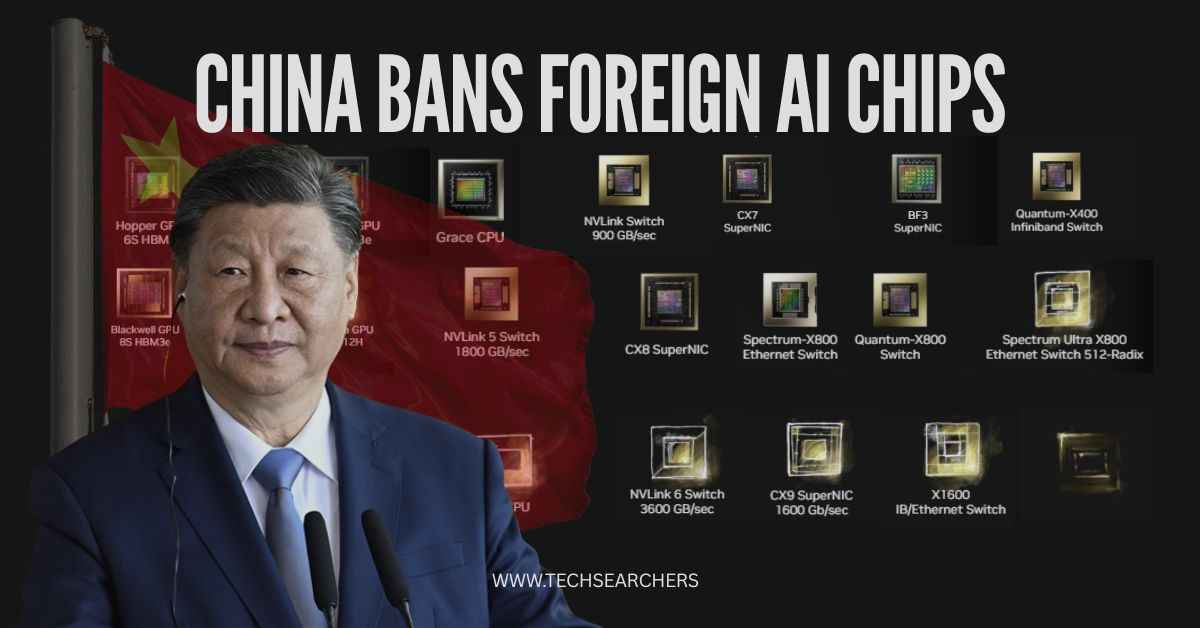
China has imposed a sweeping ban on foreign AI chips in all state-funded data centers, signaling its strongest push yet for tech sovereignty. The new directive orders the removal of Nvidia, AMD, and Intel accelerators from government-backed projects, requiring a full transition to Chinese-made AI processors. This bold move aims to reduce dependence on U.S. technology amid tightening export controls and escalating tech tensions.
Leading domestic firms — including Huawei (developer of Ascend AI chips), Cambricon Technologies, Iluvatar CoreX, Enflame Technology, and MetaX — are now stepping in to fill the gap. These companies are rapidly advancing GPU and AI accelerator production to power China’s growing artificial intelligence ecosystem.
Industry analysts predict the U.S. could lose $7–10 billion annually in chip sales, with Nvidia suffering the greatest impact due to its dominant market share. China’s decisive action is reshaping the global AI hardware landscape and intensifying the U.S.–China technological rivalry for semiconductor supremacy.
Key Highlights
- China orders all state-funded data center projects to use only domestic AI chips.
- Foreign chips, including Nvidia H20, H200, and B200, must be removed in early-stage builds.
- Projects under 30% completion must replace existing U.S. hardware immediately.
- The crackdown impacts billions in U.S. chipmaker revenue and boosts Huawei and Cambricon.
China’s New AI Chip Ban Explained
According to reports from early November 2025, the Chinese government has quietly issued an internal directive instructing all data center projects receiving state funding to use only Chinese-made AI accelerators. This includes powerful domestic chips from companies like Huawei, Cambricon, and Enflame.
What makes this move significant is that it targets even Nvidia’s H20, a special GPU designed specifically to comply with U.S. export rules, and also blocks the restricted H200 and B200 chips that often reach China through grey market channels.
For ongoing projects, the rules apply retroactively. Any build that is less than 30% complete must remove all installed foreign chips immediately and cancel future orders. Projects past the 30% mark will be reviewed individually, depending on the cost and progress of construction.
This decision effectively erases Nvidia’s earlier dominance in China, where it once held more than 90% of the AI accelerator market.
Why China Is Enforcing This Ban
China has invested more than $100 billion into AI infrastructure since 2021, and the government views foreign technology as a national risk, especially during rising political tensions with the U.S. The new directive aims to secure long-term chip independence and reduce dependency on American semiconductor giants.
Chinese hardware has improved rapidly, but still trails Nvidia and AMD in software support and performance density. Huawei’s Ascend series, often seen as the strongest domestic alternative, still lacks the mature software ecosystem of Nvidia’s CUDA platform.
However, with billions in government support and now guaranteed adoption in state-backed projects, domestic vendors are expected to accelerate quickly.
Why the Ban Matters: Impact on Global AI Development
China has invested over $100 billion into AI infrastructure since 2021, making this ban a massive shake-up for the global chip ecosystem.
Impact on China
- Strengthens the domestic chip ecosystem.
- Reduces reliance on U.S. technology.
- Aligns with national “data sovereignty” goals.
However, Chinese chips like Huawei’s Ascend series still lack full parity with Nvidia’s CUDA ecosystem, creating a gap in performance and developer tooling.
Impact on Nvidia, AMD, and Intel
- Nvidia’s China market share has already dropped to near zero.
- AMD and Intel lose a significant long-term revenue stream.
- Restrictions force U.S. companies to focus on other regions.
Geopolitical Context
The ban is unfolding amid heated U.S.–China trade tensions and follows recent discussions between President Trump and President Xi regarding advanced semiconductor access. Recent Chinese port seizures of Nvidia hardware also hinted that stronger policies were coming.
This directive formalizes the shift: China wants complete AI chip self-sufficiency.
How Domestic Chipmakers Benefit
The ban immediately boosts companies like Huawei, Cambricon, and Enflame. These firms now gain exclusive access to a market previously dominated by U.S. accelerators. With growing pressure to advance AI performance locally, China is expected to fast-track innovation across its semiconductor sector.
Foreign vs Domestic AI Accelerators
| Feature | Nvidia H20 | Huawei Ascend 910B | Impact |
| Performance | Higher overall performance | Competitive but lower | Reduces peak GPU power in China |
| Software Ecosystem | CUDA and TensorRT | CANN | Developers must switch toolchains |
| Export Status | Restricted | Fully allowed | Ensures stable supply in China |
| Use in State Projects | Banned | Mandatory | Full shift to domestic hardware |
Conclusion
In conclusion, China bans foreign AI chipsin state-funded data centers marks a defining moment in the global tech race. By eliminating Nvidia, AMD, and Intel hardware from government projects and promoting domestic solutions from Huawei, Cambricon, Iluvatar CoreX, and Enflame, China is accelerating its drive for semiconductor independence. This policy not only strengthens its internal AI ecosystem but also challenges U.S. dominance in the chip market. Analysts estimate potential U.S. revenue losses of $7–10 billion annually, with Nvidia facing the steepest decline. Ultimately, China’s move is reshaping the AI hardware supply chain, redefining global market dynamics, and deepening the U.S.–China tech rivalry in the race for artificial intelligence leadership.
Frequently As
1. Why did China ban foreign AI chips in state-funded data centers?
China banned foreign AI chips to reduce reliance on U.S. technology, enhance national data security, and boost domestic semiconductor innovation. The government aims to strengthen its tech ecosystem amid growing U.S. export restrictions on advanced chips like Nvidia’s H100 and AMD’s MI300.
2. Which foreign companies are affected by China’s AI chip ban?
The directive primarily targets Nvidia, AMD, and Intel, whose AI accelerators powered most of China’s state data centers. These companies now face significant market losses as China transitions to homegrown alternatives.
3. Which Chinese companies are replacing Nvidia, AMD, and Intel chips?
Leading domestic firms — Huawei (Ascend AI chips), Cambricon Technologies, Iluvatar CoreX, Enflame Technology, and MetaX — are developing AI GPUs and accelerators to replace banned U.S. hardware in national projects.
4. How much loss will U.S. companies face due to China’s AI chip ban?
Analysts estimate the ban could cost U.S. chipmakers $7–10 billion annually, with Nvidia suffering the largest impact. The loss stems from China’s massive AI infrastructure investments previously dominated by American hardware.
5. How will China’s AI chip ban impact the global tech industry?
The ban will reshape the global AI hardware supply chain, accelerate China’s semiconductor self-sufficiency, and intensify U.S.–China tech tensions. It may also trigger more investment in non-U.S. chip ecosystems and redefine future AI innovation hubs.
