
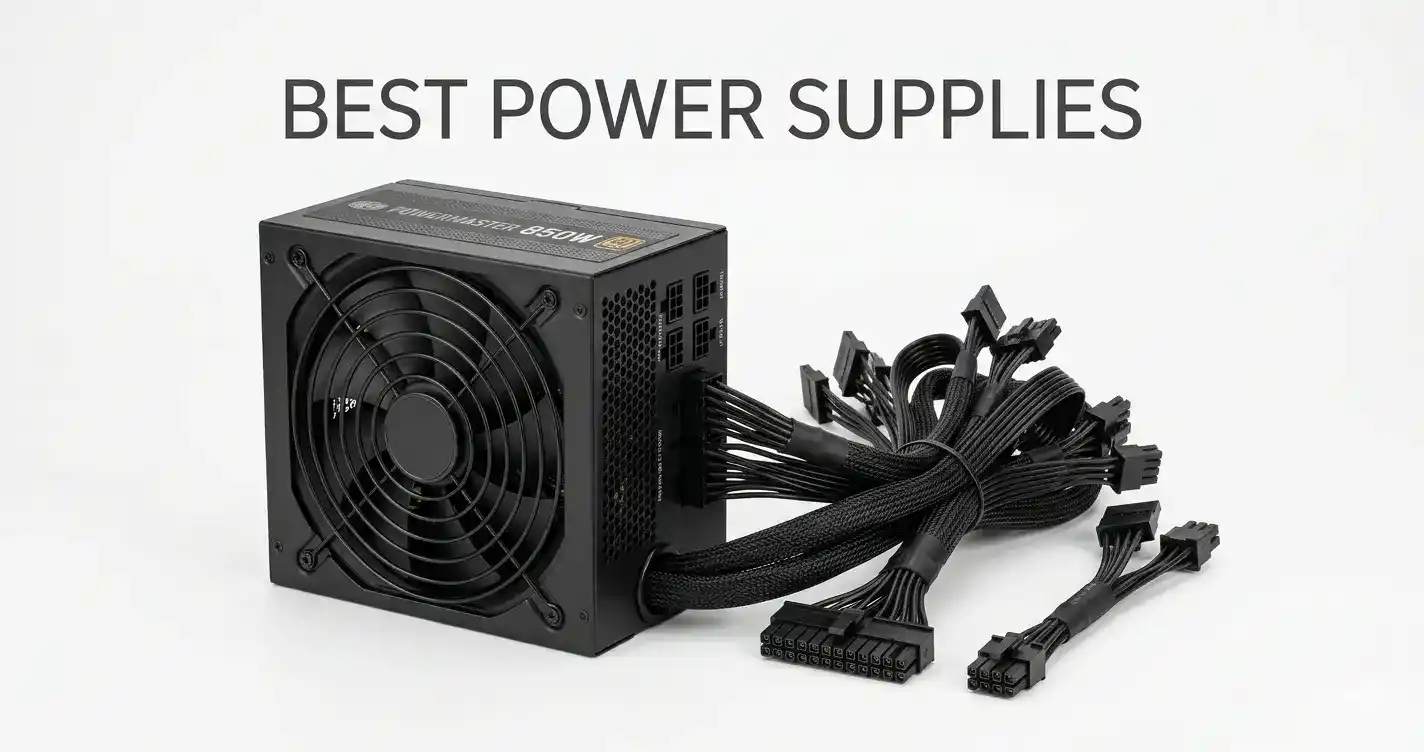
Choosing the right power supply unit (PSU) in 2026 is more important than ever. With next-generation GPUs like the RTX 5090 drawing nearly 400W on their own, your PSU is no longer just a background component — it is the backbone of your entire build. The latest ATX 3.1 and PCIe 5.1 standards demand units that can handle massive power spikes without flinching. Whether you are building a flagship gaming rig, a creative workstation, or a future-proof daily driver, picking the wrong PSU can damage your entire system. In this guide, we cover the 7 best power supplies available on Amazon right now 4 confirmed 2026 launches and 3 top-selling 2025 models — with full specs, honest pros and cons, and direct buy links.
Quick Comparison Table:
| Model | Year | Wattage | Standard | Buy |
|---|---|---|---|---|
| MSI MPG Ai1600TS PCIe 5 | 2026 | 1600W | ATX 3.1 / PCIe 5.1 | Amazon |
| MSI MPG Ai1300TS PCIe 5 | 2026 | 1300W | ATX 3.1 / PCIe 5.1 | Amazon |
| Thermaltake Toughpower TF3 1650W | 2026 | 1650W | ATX 3.1 / PCIe 5.1 | Amazon |
| Corsair RMx SHIFT Gen 2 (850W–1200W) | Apr 2026 | 850W–1200W | ATX 3.1 / PCIe 5.1 | Amazon |
| ASUS ROG Thor 1200W Platinum III | 2025 | 1200W | ATX 3.1 / PCIe 5.1 | Amazon |
| Corsair HX1500i (2025) | 2025 | 1500W | ATX 3.1 / PCIe 5.1 | Amazon |
| NZXT C1000 Gold ATX 3.1 | 2025 | 1000W | ATX 3.1 / PCIe 5.1 | Amazon |
2026 PSU Launches
1. MSI MPG Ai1600TS PCIe 5 — Best Titanium PSU for Extreme Builds
Launch Date: Early 2026 Overview: The MSI MPG Ai1600TS is MSI’s most advanced power supply to date. Built with Silicon Carbide (SiC) MOSFETs, this unit pushes efficiency into Titanium territory while adding GPU Safeguard+ protection — a dedicated circuit that cuts power before a GPU failure cascade damages your entire system. At 1600W with a 12-year warranty, it is designed for dual-GPU workstations and enthusiast builds running RTX 5090-class hardware.
Full Specifications
| Specification | Detail |
|---|---|
| Brand | MSI |
| Model | MPG Ai1600TS PCIe 5 |
| Wattage | 1600W |
| Efficiency Rating | 80 Plus Titanium |
| Standard | ATX 3.1 / PCIe 5.1 |
| MOSFET Type | Silicon Carbide (SiC) |
| Connector Type | Fully Modular |
| Warranty | 12 Years |
| Price | ~$380 |
Key Features
- GPU Safeguard+ protection circuit prevents cascade GPU damage
- Silicon Carbide MOSFETs deliver class-leading thermal efficiency
- ATX 3.1 and PCIe 5.1 native support — no adapters needed
- 12-year warranty, one of the longest in the PSU industry
- Built for continuous high-wattage loads from RTX 5090 / RX 9090 class GPUs
- Fully modular cable design reduces clutter and improves airflow
- Advanced OVP, OCP, UVP, SCP, and OTP protections included
Pros and Cons
| Pros | Cons |
|---|---|
| Titanium efficiency saves electricity over time | Premium price (~$380) |
| 12-year warranty is industry-leading | Overkill for mid-range builds |
| GPU Safeguard+ is a genuine innovation | Large physical footprint |
| SiC MOSFETs run cooler and last longer | Limited availability at launch |
2. MSI MPG Ai1300TS PCIe 5 — Best 1300W Titanium for Single-GPU Enthusiasts
Launch Date: Early 2026 Overview: The MSI MPG Ai1300TS is the slightly smaller sibling of the Ai1600TS, targeting single-GPU enthusiast builds at a more accessible price. At 1300W, it comfortably powers an RTX 5090 with a high-end CPU like Intel Core Ultra 9 or AMD Ryzen 9 9950X, with headroom to spare. The same GPU Safeguard+ technology and SiC MOSFETs found in the 1600W version are carried over, making this arguably the best value Titanium PSU of 2026.
Full Specifications
| Specification | Detail |
|---|---|
| Brand | MSI |
| Model | MPG Ai1300TS PCIe 5 |
| Wattage | 1300W |
| Efficiency Rating | 80 Plus Titanium |
| Standard | ATX 3.1 / PCIe 5.1 |
| MOSFET Type | Silicon Carbide (SiC) |
| Connector Type | Fully Modular |
| Warranty | 12 Years |
| Price | ~$320 |
Key Features
- Same GPU Safeguard+ system as the flagship 1600W model
- SiC MOSFETs for superior efficiency at all load levels
- Native PCIe 5.1 12V-2×6 connector — zero adapter risk
- 12-year warranty standard across the MPG Ai series
- Optimized for single RTX 5090 / RX 9090 builds
- Whisper-quiet fan with semi-passive zero-RPM mode at low loads
- Full suite of OVP, UVP, OCP, SCP, and OTP protections
Pros and Cons
| Pros | Cons |
|---|---|
| Titanium efficiency at a lower price than 1600W version | Still expensive versus Gold-rated alternatives |
| GPU Safeguard+ protects your $2,000+ GPU investment | Not ideal for dual-GPU workstations |
| 12-year warranty covers you for the life of multiple builds | SiC MOSFET repairs are specialized |
| Fully modular for clean builds | Heavy unit — check case clearance |
3. Thermaltake Toughpower TF3 1650W — Best Wattage for 2026 Workstation Builds
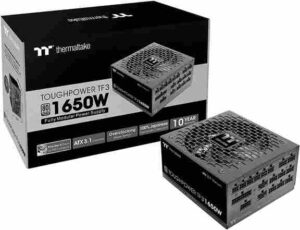
Launch Date: Early 2026 Overview: The Thermaltake Toughpower TF3 1650W stands out as the highest-wattage consumer Titanium PSU readily available on Amazon in 2026. Its dual 12V-2×6 connectors make it a natural pick for multi-GPU workstation builds. The OCM (Overclocking Mode) toggle is a unique feature that lets users manually push beyond default power limits, a feature rare in PSUs at any price point. Flat ribbon cables round out an excellent package for builders who prioritize cable management.
Full Specifications
| Specification | Detail |
|---|---|
| Brand | Thermaltake |
| Model | Toughpower TF3 |
| Wattage | 1650W |
| Efficiency Rating | 80 Plus Titanium |
| Standard | ATX 3.1 / PCIe 5.1 |
| Connectors | Dual 12V-2×6 (PCIe 5.1 native) |
| Cable Type | Flat Ribbon (Fully Modular) |
| OCM Toggle | Yes |
| Price | ~$300 |
Key Features
- Dual 12V-2×6 connectors for multi-GPU or SLI workstation setups
- OCM toggle allows users to push beyond default power limits for extreme overclocking
- Flat ribbon cables dramatically improve airflow in compact cases
- 1650W output at Titanium efficiency — lowest operating cost of any PSU on this list
- Native ATX 3.1 compliance for full compatibility with 2025–2026 motherboards
- High-quality Japanese capacitors for long operational lifespan
- Dual EPS 8-pin connectors for high-core-count workstation CPUs
Pros and Cons
| Pros | Cons |
|---|---|
| Highest wattage Titanium unit in this guide | No GPU Safeguard-type protection |
| Flat cables are the best for tight builds | OCM mode voids warranty if misused |
| Dual 12V-2×6 perfect for pro workstations | Slightly lower brand recognition vs MSI/Corsair |
| ~$300 is strong value for 1650W Titanium | Bulky — measure your case depth first |
4. Corsair RMx SHIFT Gen 2 (850W–1200W) — Best Mainstream PSU of 2026
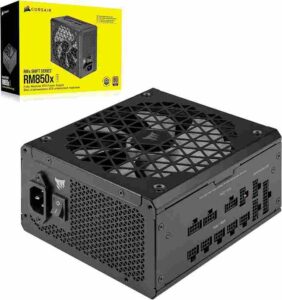
Launch Date: April 2026 Overview: The Corsair RMx SHIFT Gen 2 is the most anticipated mainstream PSU launch of 2026. The defining innovation is side-mounted connectors — instead of cables coming out the front of the PSU, they exit from the side, dramatically simplifying routing in modern ATX and ITX cases. Available in 850W, 1000W, and 1200W variants, the SHIFT Gen 2 fits the majority of gaming builds at a very competitive price while meeting the full ATX 3.1 and PCIe 5.1 standard. The 10-year warranty makes it an exceptional value at the Gold tier.
Full Specifications
| Specification | Detail |
|---|---|
| Brand | Corsair |
| Model | RMx SHIFT Gen 2 |
| Wattage | 850W / 1000W / 1200W |
| Efficiency Rating | 80 Plus Gold |
| Standard | ATX 3.1 / PCIe 5.1 |
| Fan Mode | Zero RPM (semi-passive) |
| Connector Layout | Side-mounted (unique design) |
| Warranty | 10 Years |
| Price | ~$130–$200 |
Key Features
- Side-mounted connectors make cable routing dramatically cleaner
- Zero RPM fan mode for completely silent operation under light loads
- ATX 3.1 and PCIe 5.1 ready — full compatibility with all 2026 GPUs
- Available in three wattages: 850W, 1000W, and 1200W
- 10-year Corsair warranty — best in class for Gold-rated units
- Fully modular design with premium sleeved cables included
- Suitable for RTX 5080 and RTX 5070 Ti builds without breaking the budget
Pros and Cons
| Pros | Cons |
|---|---|
| Side connectors are a game-changer for cable management | Gold efficiency, not Titanium |
| Covers 850W–1200W needs in one product family | April 2026 launch — limited early stock |
| 10-year warranty is exceptional for Gold-rated PSU | Not ideal for RTX 5090 at 850W variant |
| Most affordable fully modern PSU on this list | Gold units cost slightly more to run over time vs Titanium |
5. ASUS ROG Thor 1200W Platinum III — Best Premium Gaming PSU
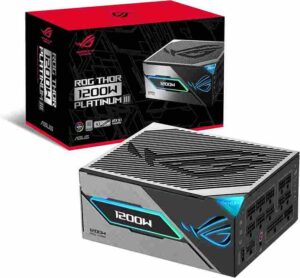
Launch Date: 2025 Overview: The ASUS ROG Thor 1200W Platinum III is the showpiece PSU for premium gaming builds. Its magnetic OLED display shows real-time wattage consumption — an aesthetic and practical feature no other PSU on this list offers. GaN (Gallium Nitride) MOSFETs and the GPU-First IVS (Intelligent Voltage Supply) system prioritize power delivery to your GPU during sudden load spikes, reducing micro-stutters in demanding games. At $375, it is priced for enthusiasts who want their PSU to be as impressive as the rest of their build.
Full Specifications
| Specification | Detail |
|---|---|
| Brand | ASUS ROG |
| Model | Thor 1200W Platinum III |
| Wattage | 1200W |
| Efficiency Rating | 80 Plus Platinum |
| Standard | ATX 3.1 / PCIe 5.1 |
| MOSFET Type | GaN (Gallium Nitride) |
| Display | Magnetic OLED wattage monitor |
| Warranty | 10 Years |
| Price | ~$375 |
Key Features
- Magnetic OLED display shows live power draw — great for monitoring and aesthetics
- GaN MOSFETs for improved efficiency and a smaller thermal footprint
- GPU-First IVS technology prioritizes GPU power during sudden load spikes
- Native PCIe 5.1 12V-2×6 connector included
- Fully modular with ROG-branded braided cables
- ATX 3.1 compliant for current and upcoming motherboard standards
- 10-year ASUS ROG warranty with premium build quality
Pros and Cons
| Pros | Cons |
|---|---|
| OLED display is genuinely useful for power monitoring | $375 is expensive for Platinum (not Titanium) |
| GaN MOSFETs are more reliable long-term | Heavy and premium-sized unit |
| GPU-First IVS reduces GPU micro-stutters | OLED display adds a small failure point over time |
| Best aesthetics of any PSU on this list | Overkill features for simple builds |
6. Corsair HX1500i (2025) — Best High-Wattage Smart PSU
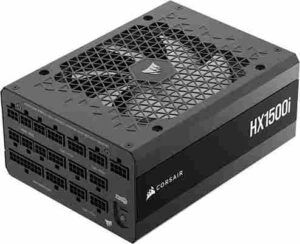
Launch Date: 2025 Overview: The Corsair HX1500i is the smartest PSU on this list. Via the iCUE software platform, users can monitor real-time voltage, wattage, and temperature data for every single rail — a feature that serious overclockers and system builders genuinely use. Cybenetics Platinum certification adds an independent layer of verified efficiency testing beyond 80 Plus. The FDB (Fluid Dynamic Bearing) fan is near-silent under normal loads. At 1500W, this is the go-to unit for anyone running an RTX 5090 with heavy overclocking headroom to spare.
Full Specifications
| Specification | Detail |
|---|---|
| Brand | Corsair |
| Model | HX1500i (2025) |
| Wattage | 1500W |
| Efficiency Rating | 80 Plus Platinum / Cybenetics Platinum |
| Standard | ATX 3.1 / PCIe 5.1 |
| Fan Type | FDB (Fluid Dynamic Bearing) |
| Software | iCUE (real-time monitoring) |
| Warranty | 10 Years |
| Price | ~$340 |
Key Features
- iCUE integration provides per-rail voltage, temperature, and wattage monitoring
- Cybenetics Platinum certification — independently verified efficiency
- FDB fan is significantly quieter and longer-lasting than ball-bearing fans
- 1500W output with ATX 3.1 compliance for RTX 5090 and beyond
- Fully modular with premium low-resistance cables
- Zero RPM fan mode for silent operation under light loads
- One of the most data-transparent PSUs available to consumers
Pros and Cons
| Pros | Cons |
|---|---|
| iCUE monitoring is genuinely useful for builders and overclockers | Requires iCUE software for full feature access |
| Dual efficiency certifications (80 Plus + Cybenetics) | $340 is steep for Platinum, not Titanium |
| FDB fan is quiet and long-lasting | Large unit — tight cases may struggle |
| 1500W gives enormous headroom for overclocking | Software dependency can be a turnoff for minimalists |
7. NZXT C1000 Gold ATX 3.1 — Best Budget PSU of 2026
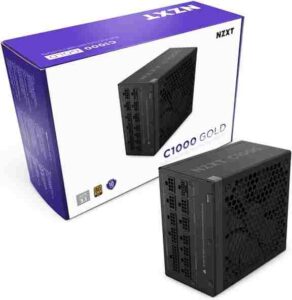
Launch Date: 2025 Overview: At ~$110, the NZXT C1000 is the undisputed best-value PSU on this list. It delivers 1000W of Gold-rated efficiency using 100% Japanese capacitors — a component quality standard rarely seen at this price point. Zero fan mode keeps it completely silent during light tasks, and full ATX 3.1 / PCIe 5.1 compliance means it works natively with every current-generation GPU. For mainstream gaming builds running RTX 5070, RTX 5070 Ti, or AMD RX 9070 XT cards, the C1000 is the smart, no-compromise choice.
Full Specifications
| Specification | Detail |
|---|---|
| Brand | NZXT |
| Model | C1000 Gold ATX 3.1 |
| Wattage | 1000W |
| Efficiency Rating | 80 Plus Gold |
| Standard | ATX 3.1 / PCIe 5.1 |
| Capacitors | 100% Japanese |
| Fan Mode | Zero RPM (semi-passive) |
| Connector Type | Fully Modular |
| Price | ~$110 |
Key Features
- 100% Japanese capacitors for reliability and longevity above the price class
- Zero fan mode for completely silent running at low-to-medium loads
- Full ATX 3.1 and PCIe 5.1 compliance — future-ready for 2026 and beyond
- Fully modular design included at this price point (rare for under $120)
- Clean NZXT minimalist design fits white and black builds equally well
- Adequate 1000W capacity for any single-GPU mainstream or mid-high gaming build
- Strong community reputation for reliability over multi-year use
Pros and Cons
| Pros | Cons |
|---|---|
| Best price-to-performance ratio on this list at ~$110 | Gold efficiency, not Platinum or Titanium |
| 100% Japanese caps at this price is genuinely impressive | 1000W may be tight for RTX 5090 under heavy OC |
| Zero RPM fan for silent everyday use | No monitoring features or display |
| Fully modular for a sub-$120 PSU is rare | Shorter warranty vs premium competitors |
Conclusion
The power supply market in 2026 is the strongest it has ever been. The MSI MPG Ai1600TS and Ai1300TS set a new standard for GPU protection with Safeguard+ and SiC MOSFETs. The Thermaltake TF3 1650W is the go-to for workstation builders demanding peak wattage at Titanium efficiency. Corsair’s RMx SHIFT Gen 2 reimagines cable management at a mainstream price point.
Before purchasing any PSU, use a PSU wattage calculator — tools like OuterVision or PCPartPicker’s power estimator factor in your exact CPU, GPU, and peripherals to ensure you never under- or over-buy. Overspending on wattage you will never use is as common a mistake as underpowering a high-end build.
Whatever your setup, every PSU on this list is ATX 3.1-ready and built to last well beyond 2026.
Frequently Asked Questions (FAQs)
What is the best PSU for an RTX 5090 build in 2026?
The MSI MPG Ai1300TS PCIe 5 (1300W, Titanium) is the best single-PSU choice for an RTX 5090 build. The RTX 5090 draws approximately 394W under load, and a high-end CPU like the AMD Ryzen 9 9950X or Intel Core Ultra 9 can add another 150–200W. The Ai1300TS provides 1300W of Titanium-rated output with the added GPU Safeguard+ system that cuts power before a GPU fault causes system-wide damage. For extreme overclocking headroom, step up to the Ai1600TS.
What does ATX 3.1 mean, and do I need it?
ATX 3.1 is the latest power supply standard released by Intel in 2024–2025. It mandates support for large transient power spikes — up to 200% of the PSU’s rated wattage for short bursts — which is critical for modern GPUs like the RTX 5090 that can spike power demand dramatically in milliseconds. All 7 PSUs on this list are ATX 3.1 compliant, meaning they handle these spikes without triggering protection shutdowns. If you are buying a new PSU in 2026, ATX 3.1 support is non-negotiable.
Is a Titanium PSU worth it over Gold for gaming?
It depends on usage hours and electricity cost. A Titanium PSU operates at over 94% efficiency at full load, compared to roughly 90% for a Gold unit. For a system running 8+ hours per day, the energy savings add up meaningfully over years of use — potentially paying back the price premium within 2–3 years depending on your local electricity rate. For casual gamers using their PC 2–3 hours daily, a Gold-rated PSU like the Corsair RMx SHIFT Gen 2 or NZXT C1000 is perfectly adequate and saves money upfront.
What is PCIe 5.1 and why does my PSU need it?
PCIe 5.1 refers to the updated 12V-2×6 power connector standard introduced alongside ATX 3.1. It replaces the older 8-pin PCIe connector with a more robust, safer connector designed to handle the higher current demands of flagship GPUs. All 2025 and 2026 high-end GPUs — including the RTX 5090, RTX 5080, and RX 9090 — use this connector. Using an older PSU with a 6+2 to 12V-2×6 adapter introduces fire and stability risks. All PSUs on this list include native 12V-2×6 connectors.
How much wattage do I actually need for my PC build?
As a practical rule: add up your GPU TDP, CPU TDP, and 150W for all other components (RAM, storage, fans, motherboard), then add 20–30% headroom. For an RTX 5090 (394W) + Ryzen 9 9950X (170W) + 150W system = ~714W baseline. Add 25% headroom = ~893W minimum. A 1000W Gold unit is the safe floor; a 1300W Titanium unit is ideal for overclocking or future GPU upgrades. For RTX 5070 or RX 9070 builds, 850W Gold is entirely sufficient.
Which PSU has the best warranty in 2026?
The MSI MPG Ai1600TS and Ai1300TS lead with 12-year warranties — the longest standard warranty in the consumer PSU market. The Corsair RMx SHIFT Gen 2, Corsair HX1500i, and ASUS ROG Thor Platinum III all carry 10-year warranties. The NZXT C1000 offers a shorter but still solid warranty for its price class. Longer warranties matter for PSUs because they are run continuously and degrade over time — a 10–12 year warranty effectively means the manufacturer stands behind the unit for the life of 3–4 typical PC build cycles.
Is the Corsair RMx SHIFT Gen 2 good for first-time PC builders?
Yes — the Corsair RMx SHIFT Gen 2 is arguably the best choice for first-time builders among all units on this list. The side-mounted connectors make cable routing significantly easier because cables do not need to bend sharply around the PSU shroud. Gold efficiency keeps running costs reasonable. The 850W variant is sufficient for any mainstream GPU including the RTX 5080, and the 10-year warranty means it is a purchase you will not need to revisit for a long time. At $130–$200, it delivers outstanding long-term value.
