
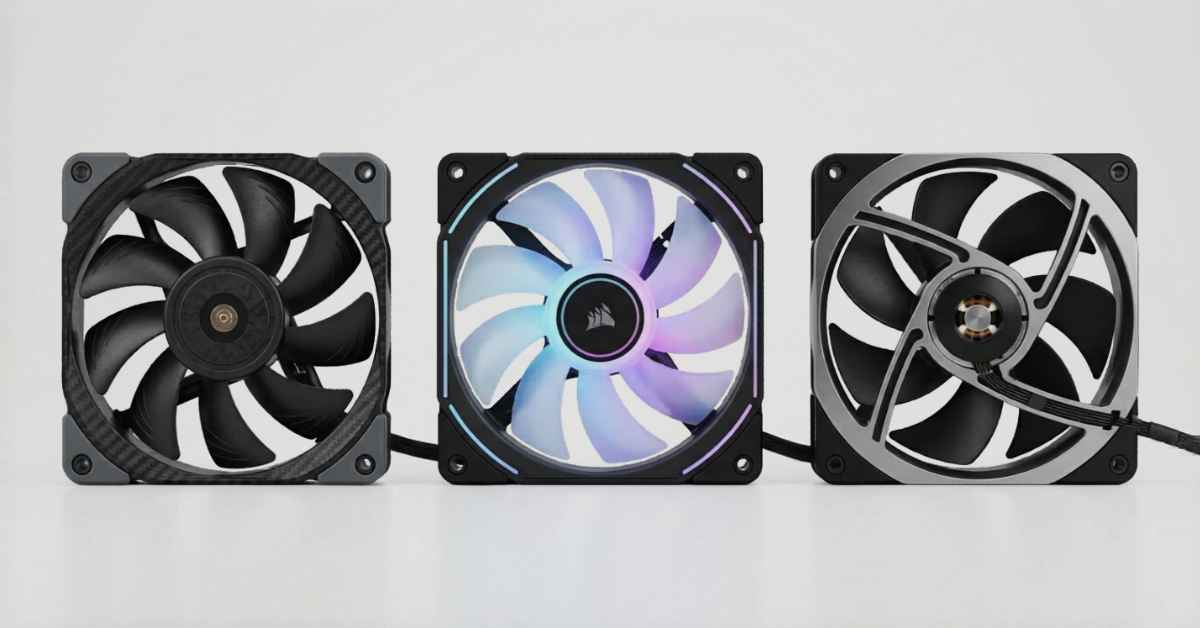
Most PC builders spend hundreds of dollars choosing the right CPU and GPU, then pick fans as an afterthought. That is a mistake. Case fans are the first and last line of defense for every component inside your system.
Poor airflow leads to thermal throttling the automatic reduction of CPU or GPU clock speeds to prevent overheating. When your processor hits its temperature limit during a gaming session or a render job, it does not ask for permission; it simply slows down. The performance you paid for disappears silently. Good fans prevent that.
Beyond raw performance, fans affect acoustics. A poorly chosen fan at 2,000 RPM can sound like a hair dryer. A well-engineered fan running at the same speed can be nearly inaudible. The difference is blade geometry, bearing quality, and motor design factors that vary enormously across price brackets.
In 2026, the fan market has matured considerably. Magnetic levitation bearings have become common in mid-range products. LCP (Liquid Crystal Polymer) blade construction, once reserved for Noctua’s flagship models now appears in fans priced under $35. Daisy-chain wiring, 30mm thick frames, and wireless RGB ecosystems are no longer novelties. This guide cuts through the noise and tells you exactly which fans earn a place in your system.
How We Selected These Fans
The fans in this list were selected based on the following criteria:
- Verified launch date confirmed through manufacturer announcements, retail listings, and independent review publications
- Current availability on Amazon.com USA at time of writing (May 2026)
- Independent benchmark data from sources including Tom’s Hardware, PC Gamer, Hardware Busters, and TechPowerUp
- Real-world noise-normalized performance, meaning airflow comparisons are made at equal noise output rather than equal RPM
- Value across categories — best overall, best budget, best silent, best RGB, and best high-performance each have a different winner
- No paid placements — no manufacturer has influenced the rankings or content of this article
The 7 Best PC Fans of 2026
| Fan | Launch Date | Best For | Size | Max RPM | Amazon |
|---|---|---|---|---|---|
| Noctua NF-A12x25 G2 PWM | June 24, 2025 | Best Overall / Quietest | 120mm | 1,800 | ~$35 |
| Corsair RS120 MAX | May 2025 | Best 30mm High-Pressure | 120mm | 2,000 | ~$35 |
| Arctic P12 Pro | Mid 2024 | Best Budget | 120mm | 3,000 | ~$9 |
| Lian Li UNI Fan SL-Infinity Wireless | July 2025 | Best Wireless / RGB | 120mm | 2,100 | ~$105 (3-pack) |
| Phanteks T30-120 | Aug 2021 | Best Raw Performance | 120mm | 3,000 | ~$35 |
| be quiet! Silent Wings 4 PWM | Jan 2023 | Best Silent Fan | 120/140mm | 1,900 | ~$25 |
| Corsair iCUE Link QX120 RGB | June 2023 | Best Smart RGB | 120mm | 2,400 | ~$130 (kit) |
1. Noctua NF-A12x25 G2 PWM — Best Overall
Launch Date: June 24, 2025 | Size: 120mm
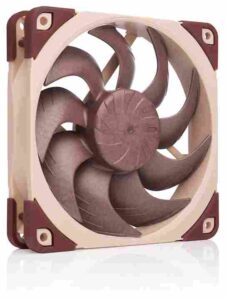
The NF-A12x25 G2 is the direct successor to what was already considered the best 120mm fan on the market for nearly a decade. Noctua took the original NF-A12x25 — a fan so good that competitors used it as the benchmark they tried to beat — and redesigned it from the motor up.
The result is a fan that delivers around 9% more airflow than its predecessor at the same noise level. On a 120x49mm radiator under a 200W heat load, Noctua’s internal testing showed a 3.5°C improvement over the original. On heatsinks, the gain is smaller (~1°C) but consistent. Tom’s Hardware testing confirmed it is the only fan in their current test suite that runs quieter on a radiator than it does suspended in open air — an unusual and meaningful result.
Key Features
- Progressive-Bend impeller geometry manufactured from Sterrox LCP for exceptional rigidity
- 0.5mm tip clearance between blade and frame — among the tightest tolerances of any mass-produced fan
- Centrifugal Turbulator Hub improves flow attachment across the impeller
- Ultra-low-loss etaPERF motor with Smooth Commutation Drive 2 for near-zero mechanical noise
- SupraTorque feature maintains target speed against back pressure on radiators and heatsinks
- New 3-phase motor design
- SSO2 bearing — Noctua’s reference-class magnetic bearing system
- Available in standard PWM (1,800 RPM max), LS-PWM ultra-quiet variant (1,100 RPM max), and Sx2-PP two-fan push-pull set
- 6-year manufacturer warranty
- Anti-vibration mounting included
Pros & Cons
| Pros | Cons |
|---|---|
| Measurably quieter than any fan in its class at equivalent airflow | Brown/beige color scheme puts off many builders |
| Zero audible mechanical noise in testing | No RGB or ARGB option |
| True all-rounder — excels in case, radiator, and heatsink applications | Pricey at ~$35 per fan |
| Improved performance without increasing RPM ceiling | Black (chromax) version still delayed as of May 2026 |
| Industry-leading build quality and 6-year warranty | No daisy-chain connector |
Best for: Builders who prioritize silence and sustained performance above aesthetics. Also the top choice for use with premium air coolers and thin radiators.
2. Corsair RS120 MAX — Best 30mm High-Pressure Fan
Launch Date: May 2025 | Size: 120mm (30mm thick)
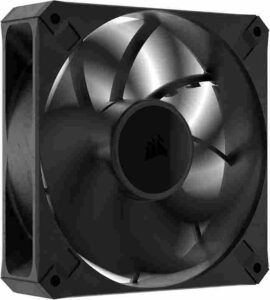
Corsair’s RS120 MAX is a 30mm thick fan — 5mm deeper than the standard 120mm form factor — and that extra volume matters. A thicker frame means longer blades, which means more air moved per revolution, which means lower RPM is needed to hit the same cooling target, which means less noise.
In independent reviews from ExtremeHW and Hardware Busters, the RS120 MAX competes directly with the Phanteks T30-120 at the top of the 30mm performance bracket. Corsair reaches 72 CFM of airflow with 4.2mm-H2O of static pressure — figures that make it one of the strongest radiator fans available in 2026.
Unlike the Phanteks T30-120, the RS120 MAX uses a Magnetic Dome bearing, which Corsair says is an evolution of standard magnetic levitation tech, and connects with a standard 4-pin PWM header — no proprietary ecosystem required.
Key Features
- 30mm thick frame (5mm thicker than standard 120mm fans)
- Liquid Crystal Polymer (LCP) blade and frame construction for blade rigidity and vibration reduction
- CORSAIR AirGuide Technology: anti-vortex vanes direct airflow toward target components
- Magnetic Dome bearing for reduced friction, longevity, and quieter operation
- Standard 4-pin PWM — no controller required
- Up to 2,000 RPM, 72 CFM airflow, 4.2mm-H2O static pressure
- Available in 120mm and 140mm sizes
- 5-year warranty
Pros & Cons
| Pros | Cons |
|---|---|
| High static pressure (4.2mm-H2O) — excellent for dense radiators | 30mm thickness may not fit in cases with tight radiator clearance |
| LCP construction reduces blade flex at high RPM | No RGB or ARGB variant |
| No proprietary controller or hub needed | Priced at the premium end for a non-RGB fan |
| AirGuide vanes improve airflow focus | Fewer blade profile customization options than Phanteks T30 |
| 5-year warranty | Relatively new — less long-term field data than Noctua or Phanteks |
Best for: High-performance water cooling builds, especially those running dense radiators where static pressure matters more than raw CFM.
3. Arctic P12 Pro — Best Budget Fan
Launch Date: Mid 2024 | Size: 120mm
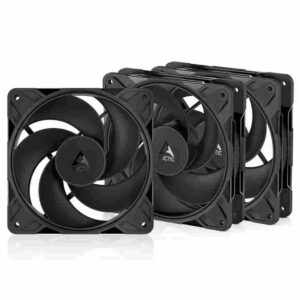
The Arctic P12 Pro sits at a price point that makes it almost unfairly good. At roughly $9 per unit, it delivers static pressure performance that competes with fans costing three to four times more. Tom’s Hardware testing placed it close to the Noctua NF-A12x25 G2 in noise-normalized airflow tests, and Hardware Busters noted its static pressure reading is actually higher than Noctua’s flagship at matched noise levels.
The PRO designation over the original P12 brings a fluid dynamic bearing (up from a simple sleeve bearing), a zero-RPM mode that stops the fan entirely below 5% PWM signal, and a speed range of 600–3,000 RPM. The 3,000 RPM ceiling is among the highest in its size class and gives builders who run aggressive fan curves genuine overhead.
It lacks the finish and the silky acoustic profile of Noctua or be quiet, and it produces slightly more tonal noise at peak speeds. But for the price — especially bought in 3-packs or 5-packs — it is the single most cost-efficient fan in 2026.
Key Features
- Fluid Dynamic Bearing (FDB) for extended lifespan and low noise
- Zero RPM mode: fan stops completely below 5% PWM for silent idle operation
- 600–3,000 RPM range with PWM control
- ARGB version (P12 Pro A-RGB) also available at a small premium
- Y-cable splitter included in multi-packs for cleaner cable management
- Available in black and white
- 6-year warranty
- Five-pack option available for full case builds
Pros & Cons
| Pros | Cons |
|---|---|
| Exceptional value — best performance-per-dollar of any fan | Slight tonal hum at high RPM compared to premium options |
| Zero-RPM mode for completely silent idle | No daisy-chain connection system |
| High 3,000 RPM ceiling for demanding workloads | Not the absolute quietest at noise-normalized comparisons |
| 6-year warranty | Basic aesthetics — frame design is functional, not striking |
| Wide availability and consistent in-stock status | ARGB version costs slightly more and loses some value edge |
Best for: Budget builds, secondary case fans supplementing a premium primary fan, and any builder who wants solid performance across an entire system without spending over $50 on fans total.
4. Lian Li UNI Fan SL-Infinity Wireless — Best Wireless & RGB Fan
Launch Date: July 2025 | Size: 120mm
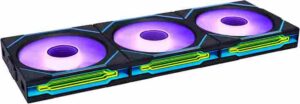
The UNI Fan SL-Infinity Wireless is the most technically ambitious consumer PC fan available in 2026. It transmits both fan speed control and RGB lighting data wirelessly over a 2.4 GHz signal — eliminating the cascade of RGB cables that has plagued multi-fan builds since addressable lighting became mainstream.
The infinity mirror effect on the SL-Infinity is genuinely impressive in person, using concentric layered reflectors spaced just 0.5mm apart. Three independently controllable light zones — the blade hub, dual side strips, and inner frame edge — give L-Connect 3 software the granularity to produce effects that flatly cannot be replicated by simpler fans.
Cooling performance is solid but secondary to aesthetics. The fan delivers 61.3 CFM of airflow at up to 2,100 RPM with a fluid dynamic bearing, and Lian Li’s interlocking daisy-chain system means only one cable runs from a cluster of four fans to the controller. The wireless receiver module handles both PWM power and signal, so the fan is detected correctly in BIOS as a standard PWM device.
Key Features
- 2.4 GHz wireless RGB and fan speed control — no separate RGB cables
- Double infinity mirror design with three independent light zones
- Interlocking daisy-chain: up to 4 fans per cluster, one cable to controller
- Fluid Dynamic Bearing for quiet operation
- 200–2,100 RPM, 61.3 CFM, 2.66 mmH2O static pressure
- Zero-RPM start/stop mode (configurable up to 50°C)
- L-Connect 3 software for full fan curve and lighting control
- Compatible with other Lian Li wireless products (SL Wireless, TL Wireless, Strimer Wireless)
- Available in 120mm and 140mm, black and white, standard and reverse airflow
Pros & Cons
| Pros | Cons |
|---|---|
| Industry-leading RGB aesthetics with true infinity mirror effect | Premium pricing — ~$35 per fan in 3-pack |
| Wireless control eliminates RGB cable clutter | Requires L-Wireless controller (included in 3-pack only) |
| Interlocking design dramatically simplifies cable management | Not the strongest performer in pure airflow benchmarks |
| Zero-RPM mode for silent idle | Slightly wider/thicker than standard 120mm — check case compatibility |
| Both airflow and reverse variants available | Wireless setup can be more complex to configure initially |
Best for: Showcase builds, RGB-focused systems, and anyone who has lost patience with cable management in a full-tower build.
5. Phanteks T30-120 — Best Raw Performance
Launch Date: August 2021 | Size: 120mm (30mm thick)
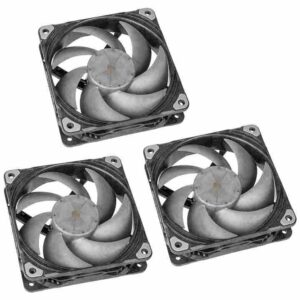
The Phanteks T30-120 launched in 2021 and still tops noise-normalized airflow charts in 2026. That longevity is a statement about how well Phanteks engineered it. Built in collaboration with SUNON, the T30 uses a 30mm thick frame with a 7-blade LCP impeller, a 3-phase motor, and a magnetic levitation dual VAPO bearing. The 0.5mm tip clearance matches Noctua’s tolerances despite the different blade geometry.
What makes the T30 special is that it operates in three distinct modes via a physical switch on the hub: quiet, balanced, and what Phanteks calls “advanced” mode (essentially maximum performance at up to 3,000 RPM). This physical profile switching means you can tune fan behavior without software — valuable in systems where fan control software may conflict with other tools.
Tom’s Hardware testing called it the best high-performance fan they have tested, noting it “outmuscles standard 120mm designs” and consistently leads when fans are tested on radiators.
Key Features
- 30mm thick frame with LCP impeller and LCP frame — both components for maximum rigidity
- 3-phase motor with magnetic levitation dual VAPO bearing
- Physical 3-mode selector on hub: Quiet / Balanced / Advanced (up to 3,000 RPM)
- 0.5mm tip clearance between blade and frame
- 7-blade design reduces leading edge noise compared to 9-blade competitors
- Daisy-chain PWM connector for multi-fan setups
- Up to 3,000 RPM, rated at approximately 78 CFM in advanced mode
- Compatible with standard 120mm mounts (check clearance for 30mm depth)
- 5-year warranty
Pros & Cons
| Pros | Cons |
|---|---|
| Best noise-normalized airflow of any 120mm fan in independent testing | 30mm thickness requires clearance check before installation |
| Physical mode selector requires no software | No RGB or ARGB version |
| Exceptional static pressure for radiator use | Industrial aesthetic — not suitable for windowed showcases |
| Daisy-chain capability for clean builds | Has been on market since 2021 — no updates or new variants |
| Competes with newer fans at the same price point | Some users report slight mechanical noise at specific RPM bands |
Best for: Extreme cooling builds, high-density radiator setups, and any builder who wants the maximum air-moving capability from a 120mm format regardless of aesthetics.
6. be quiet! Silent Wings 4 PWM — Best for Silent Builds
Launch Date: January 2023 | Size: 120mm / 140mm
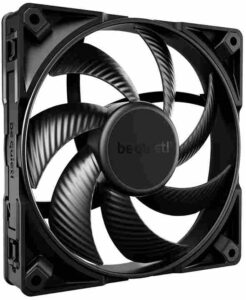
be quiet! has built its entire brand identity around low-noise engineering, and the Silent Wings 4 is the current expression of that philosophy. Launched in early 2023, it remains the top recommendation for acoustics-first builders who also need competent cooling performance — not just a fan that is quiet because it is slow.
The Silent Wings 4 uses a 6-pole motor (versus the standard 4-pole found in most competitors), which produces smoother torque delivery and reduced vibrational noise at any given RPM. The seven fan blades are shaped with a twisted leading edge to reduce turbulence and minimize tonal frequencies. At medium RPM, independent testing consistently places it in the 22–25 dBA range — genuinely inaudible in a closed case.
The Pro variant adds a high-speed mode (up to 2,400 RPM in 120mm and 3,000 RPM in 140mm) for builders who want the option of aggressive performance when the workload demands it, without compromising the fan’s acoustic quality at lower speeds.
Key Features
- 6-pole motor for reduced vibrational noise and smooth torque delivery
- Twisted blade geometry for reduced turbulence and lower tonal noise
- Fluid Dynamic Bearing for longevity and consistent low-noise operation
- Standard variant: up to 1,900 RPM (120mm) / 1,100 RPM (140mm)
- Pro variant: up to 2,400 RPM (120mm) / 3,000 RPM (140mm) — multiple speed modes
- Available in 120mm and 140mm sizes
- 3-year warranty (standard) / 5-year warranty (Pro variant)
- Anti-vibration rubber corners included
Pros & Cons
| Pros | Cons |
|---|---|
| Among the quietest fans at equivalent airflow output | Relatively modest maximum airflow vs 30mm competitors |
| 6-pole motor is a genuine acoustic engineering advantage | No ARGB version — purely functional aesthetic |
| Available in 120mm and 140mm with consistent acoustic signature | 3-year warranty on standard variant is shorter than Noctua/Arctic |
| Pro variant gives high-speed overhead without sacrificing quiet operation | Higher price than Arctic alternatives for similar airflow |
| Widely trusted in HTPC, workstation, and sleep-adjacent builds | Fan frame is standard plastic — not LCP |
Best for: Home theater PCs, workstations in quiet offices, nighttime streaming rigs, and any build where fan noise is a primary concern rather than a secondary consideration.
7. Corsair iCUE Link QX120 RGB — Best Smart Ecosystem Fan
Launch Date: June 2023 | Size: 120mm
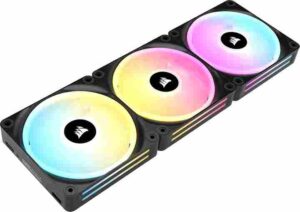
The Corsair iCUE Link QX120 is not simply a fan — it is the foundation of a digitally integrated cooling ecosystem. Each fan contains an onboard digital temperature sensor, a Magnetic Dome bearing, and a proprietary iCUE LINK connector that carries power, PWM signal, RGB data, and telemetry over a single cable. No separate RGB wires. No separate fan speed cables.
The iCUE LINK System Hub manages up to 14 iCUE LINK devices. Once set up, the software gives you per-fan RPM curves tied directly to individual component temperatures, live temperature readouts from each fan’s sensor, and one of the most comprehensive RGB control suites available on consumer hardware.
On performance, the QX120 is solid without being exceptional in raw benchmarks. Its Magnetic Dome bearing, quad light loop design, and zero-RPM mode at minimum PWM signal make it a compelling all-rounder. But the core value proposition is integration — if you are building a system around Corsair’s iCUE LINK ecosystem (AIO coolers, iCUE LINK-compatible components), the QX120 is the natural fan choice.
Key Features
- iCUE LINK single-cable connectivity: power, PWM, RGB, and telemetry in one connection
- Onboard digital temperature sensor per fan
- Magnetic Dome bearing for quiet operation and extended lifespan
- Zero RPM mode when PWM signal falls below minimum threshold
- Quad RGB light loops — four distinct rings of addressable LEDs
- 480–2,400 RPM range
- iCUE LINK System Hub required and included in starter kit
- Compatible with full Corsair iCUE LINK ecosystem
- Available in black and white, 120mm and 140mm
- 5-year warranty
Pros & Cons
| Pros | Cons |
|---|---|
| Single-cable installation per fan — cleanest wiring of any RGB fan | Starter kit price (~$130) is high for 3 fans |
| Per-fan temperature sensing enables genuinely intelligent fan curves | Requires iCUE LINK hub — adds cost and system complexity |
| Outstanding RGB quality with four full light loops | iCUE software is resource-intensive and divisive among users |
| Zero-RPM mode for silent idle | Proprietary ecosystem limits flexibility if switching brands |
| Excellent long-term ecosystem support from Corsair | Raw performance is good but not class-leading |
Best for: Builders already using or planning to use Corsair’s iCUE LINK ecosystem. Also the top choice for anyone who wants maximum smart integration and is willing to commit to one manufacturer’s software platform.
How to Choose the Right PC Fan for Your Build
Fan Size: 120mm vs 140mm
Most cases support both 120mm and 140mm fan mounts. Where possible, prefer 140mm. A larger diameter fan moves the same volume of air at lower RPM, which directly reduces noise. All seven fans in this guide are available in 120mm; several also have 140mm variants.
Bearing Type Matters More Than Most Specs
- Fluid Dynamic Bearing (FDB): Oil-lubricated rotating shaft. Quiet, long-lasting (~100,000 hour rated lifespan), no maintenance. Found in Arctic P12 Pro, Lian Li SL-Infinity Wireless, be quiet! Silent Wings 4.
- Magnetic Levitation / Magnetic Dome: No physical contact between shaft and bearing. Lowest friction, longest lifespan, very quiet. Found in Corsair QX120, RS120 MAX.
- VAPO (Vaporized Pressure): Phanteks’ proprietary bearing used in the T30-120. Similar principle to magnetic levitation — minimal contact, long life.
- SSO2 (Second-Generation Solid Spindle Oil): Noctua’s proprietary bearing. Uses a rear magnet to keep the shaft perfectly centered. Industry-standard for acoustic quality.
- Avoid: Sleeve bearings in any fan meant to run continuously. They wear out faster and generate more noise over time.
Static Pressure vs Airflow Fans
- Airflow-optimized fans (low static pressure, high CFM) are best for open case positions — front intake, rear exhaust, top exhaust — where air flows relatively freely.
- Static pressure-optimized fans (higher mmH2O rating) are best when mounted against a radiator, through a heatsink, or behind a mesh panel with significant resistance.
- Most fans in this guide are balanced all-rounders. The Phanteks T30-120 and Corsair RS120 MAX are the strongest performers specifically for radiator applications due to their 30mm thick frame.
How Many Fans Does Your Case Need?
A practical baseline for mid-tower ATX cases:
- Minimum viable: 2 intake + 1 exhaust
- Recommended: 3 intake (front) + 1 exhaust (rear) + 1 exhaust (top)
- High-performance: 3 intake + 2–3 top exhaust + 1 rear exhaust
Positive pressure configurations (more intake than exhaust) are generally preferred as they reduce dust accumulation by ensuring air only enters through filtered intakes.
RGB and Ecosystems: Plan Before You Buy
If you want addressable RGB, decide on an ecosystem before purchasing your first fan. Mixing Corsair’s iCUE LINK with Lian Li’s L-Connect system, or with ASUS Aura Sync, requires separate software running simultaneously. It is manageable but inelegant. Staying within one manufacturer’s RGB ecosystem simplifies everything and typically produces better-looking results.
Final Verdict
For most PC builders in 2026, the Arctic P12 Pro is the right starting point, it covers all the basics extremely well at a price that makes buying six of them painless. From there, upgrade the most acoustically or thermally critical positions with something from higher up this list.
The Noctua NF-A12x25 G2 earns the overall top spot because it represents the current ceiling of 25mm fan engineering. It is quiet, consistent, and built to last. If aesthetics matter, the Lian Li SL-Infinity Wireless is the current state of the art for RGB. If you are building a water-cooled system with dense radiators, the Phanteks T30-120 or Corsair RS120 MAX will outperform everything else in that specific application.
No single fan is right for every build. The table and guidance above should make it clear which one is right for yours.
Frequently Asked Questions
Is the Noctua NF-A12x25 G2 worth buying over the Arctic P12 Pro?
Yes, if low noise matters most. The Noctua G2 delivers quieter acoustics, smoother airflow sound, and better bearing durability. The Arctic P12 Pro offers far better value for budget-focused gaming PC builds.
Do 30mm PC fans fit inside normal gaming cases?
Most modern mid-tower and full-tower cases support 30mm fans. Problems usually appear in compact cases or tight radiator setups where GPU clearance, motherboard heatsinks, or front panels reduce available space.
Which fan is best for radiator cooling in 2026?
The Phanteks T30-120, Noctua NF-A12x25 G2, and RS120 MAX are among the best radiator fans because they provide high static pressure, strong airflow, and lower temperatures during gaming or workstation loads.
Are expensive premium fans actually quieter?
Yes. Premium fans use higher-quality bearings, improved blade designs, and better motor balancing. This reduces humming, vibration, and mechanical noise while maintaining strong airflow at lower RPM levels.
Should I use the same fans across my entire PC case?
Not always. Many builders use premium fans on radiators or CPU coolers and budget fans for rear or top exhaust positions. This balanced setup improves cooling performance while reducing total build cost.
What is more important: airflow or static pressure?
Airflow matters most for open case ventilation, while static pressure is critical for radiators, heatsinks, and restrictive mesh panels. High static pressure fans push air more effectively through tight spaces.
How long do high-end PC cooling fans usually last?
Quality fans from brands like Noctua, Corsair, and be quiet! commonly last 5–10 years due to premium bearings and stronger motor reliability. The user has assumed 25mm fans and left minimal clearance for tubing. Always check your case specifications for fan/radiator clearance before purchasing 30mm fans.
