
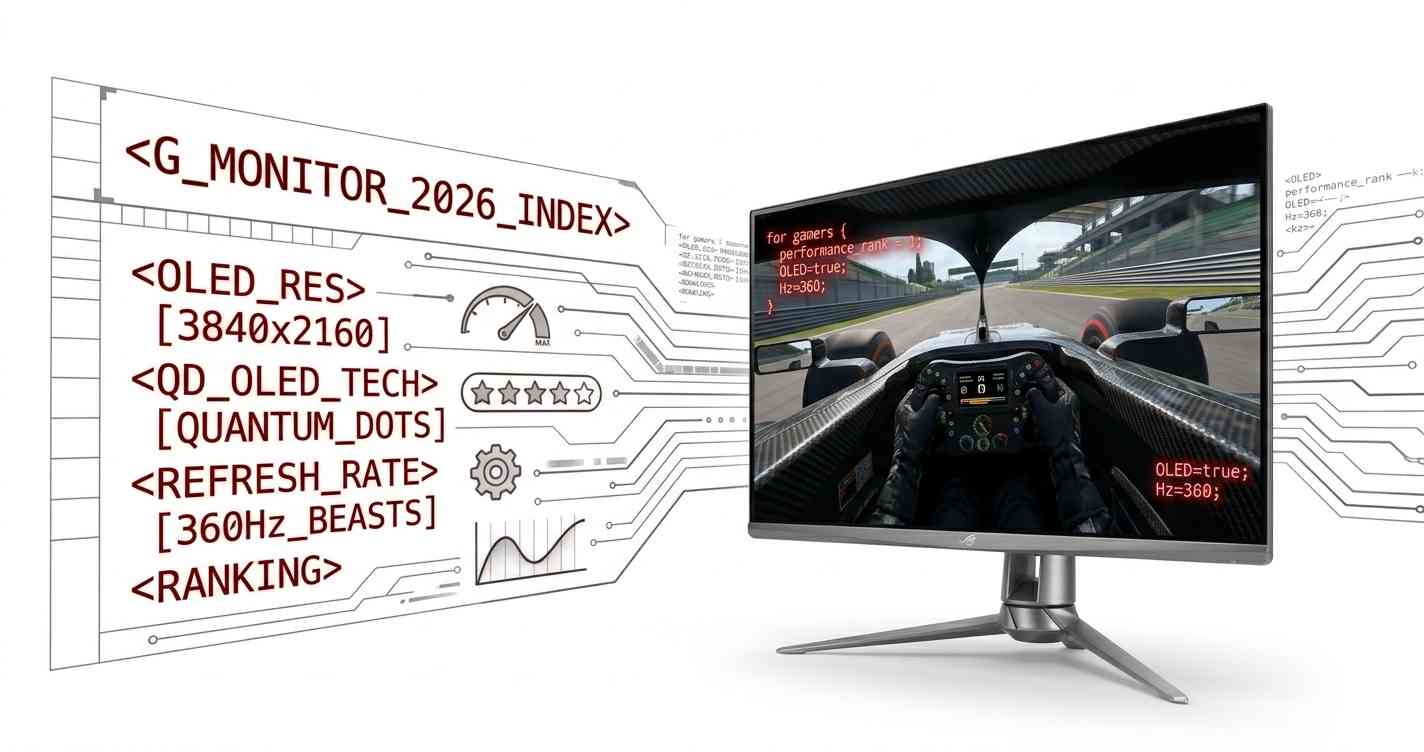
Gaming monitors in 2026 are fundamentally different from anything that came before. Samsung’s 5th generation QD-OLED panel, now shipping inside monitors from MSI and ASUS, brings three critical upgrades at once: a new RGB Stripe subpixel layout that eliminates the text fringing that plagued older OLED screens, peak brightness up to 1,300 nits certified under DisplayHDR True Black 500, and a 360Hz refresh rate in an ultrawide format for the very first time.
Meanwhile, ASUS’s WOLED Dual-Mode technology delivers both 4K/240Hz and 1080p/480Hz from a single panel, no compromise, no second monitor needed. Prices have also dropped sharply. OLED gaming is no longer a luxury reserved for flagship budgets.
What You Need to Know Before Spending a Dollar
Panel Types: QD-OLED vs WOLED
Every monitor on this list uses either QD-OLED or WOLED technology. Both are self-emissive — each pixel makes its own light — which gives you perfect blacks, near-instant response time, and contrast that no LCD can match.
QD-OLED (used by MSI and ASUS in most models) adds a quantum dot layer for wider color and higher brightness. The 5th-gen versions in 2026 are noticeably brighter and sharper than earlier generations.
WOLED (used in the ASUS PG32UCDP) is slightly different in character — excellent uniformity, and in this case it enables a unique “dual-mode” feature that lets one panel operate at both 4K/240Hz and 1080p/480Hz.
For most people: QD-OLED is the right choice in 2026.
Refresh Rate: What Actually Matters
- 240Hz — ideal for most gamers, even serious competitive players. Smooth, fast, and every GPU can realistically feed it.
- 360Hz — worth it if you play FPS games at a competitive level and your PC can push 300+ fps consistently.
- 480Hz — only available at 1080p resolution. Exclusively for pro-level competitive players. Most people will never need this.
Resolution: Speed vs Image Quality
- 1440p — easier on your GPU, higher frame rates, great for competitive gaming
- 4K — stunning image quality, especially on 27–32″ screens; needs a powerful GPU to fully use
- Ultrawide 1440p (3440×1440) — immersive field of view, great for open-world games, still GPU-friendly
DisplayPort 2.1 — Do You Need It?
Yes, if you’re buying a 4K 240Hz monitor. Without DP 2.1, the signal gets compressed. With it, 4K 240Hz runs perfectly clean. All 4K monitors on this list include DP 2.1.
The Best Gaming Monitors on Amazon in 2026
| Monitor | Size | Panel | Resolution | Refresh | USB-C PD | Price | Amazon |
|---|---|---|---|---|---|---|---|
| ASUS ROG PG32UCDP | 32″ | WOLED Dual-Mode | 4K / 1080p | 240Hz / 480Hz | 90W | ~$1,099 | Buy → |
| ASUS ROG PG32UCDM | 32″ | QD-OLED | 4K | 240Hz | 90W | ~$1,099 | Buy → |
| MSI MPG 341CQR X36 | 34″ | 5th Gen QD-OLED | 1440p UW | 360Hz | 98W | $899.99 | Buy → |
| MSI MAG 272UP X24 | 27″ | QD-OLED | 4K | 240Hz | No | TBC | Buy → |
ASUS ROG Swift PG32UCDP
🏆 Best Overall — Most Versatile Gaming Monitor in 2026
Amazon price: ~$1,099 | → Check latest price on Amazon
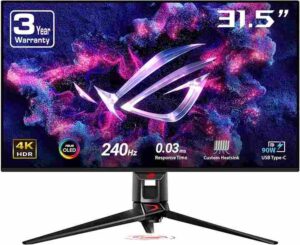
The ASUS ROG Swift PG32UCDP is the most unique gaming monitor available today. It uses a WOLED panel with a feature no other monitor has: dual-mode operation. In standard mode it runs at 4K (3840×2160) and 240Hz. Switch modes and it drops to 1080p and runs at 480Hz — the fastest refresh rate in any desktop monitor right now.
This means you get two monitors in one. Use 4K/240Hz for AAA open-world games, cinematic experiences, and creative work. Switch to 1080p/480Hz when you jump into Valorant, CS2, or any competitive FPS where frame rate is everything.
The WOLED panel covers 99% DCI-P3 color gamut, which makes it accurate enough for professional color work. The USB-C port delivers 90W of power, so a single cable connects and charges your laptop. ASUS’s 3-year warranty covers burn-in, which is rare and reassuring.
Key Specs:
- Panel: WOLED Dual-Mode
- Size: 32 inches
- Resolution: 4K (240Hz) / 1080p (480Hz)
- Response time: 0.03ms
- USB-C: 90W power delivery
- G-SYNC Compatible + FreeSync Premium
- Warranty: 3 years (burn-in included)
| Pros | Cons |
|---|---|
| Only monitor with true 4K/240Hz and 480Hz modes in one panel | 1080p at 32 inches looks noticeably soft due to low pixel density in performance mode |
| Eliminates the need for two separate monitors | WOLED is slightly less vivid compared to 5th gen QD-OLED panels |
| 99% DCI-P3 color coverage — excellent for creators | Premium price compared to single-mode alternatives |
| USB-C with up to 90W power delivery for clean single-cable laptop setups | |
| Industry-leading 3-year burn-in warranty from ASUS |
Best for: Gamers who split time between immersive games and competitive shooters and don’t want to buy two monitors.
ASUS ROG Swift PG32UCDM
🎨 Best for 4K Gaming & Content Creators
Amazon price: ~$1,099 | → Check latest price on Amazon
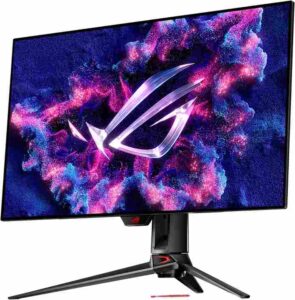
The ASUS ROG Swift PG32UCDM is the cleanest, most capable 4K gaming monitor you can buy on Amazon right now. A 32-inch QD-OLED panel at 4K resolution and 240Hz, paired with DisplayPort 2.1 UHBR20 — meaning 4K 240Hz runs completely uncompressed. No signal compression, no artifacts. Just raw, full-bandwidth 4K at 240Hz.
The QD-OLED panel covers 99% DCI-P3, making this monitor genuinely useful for video editing, photo work, and color-critical creative tasks — not just gaming. At 32 inches, 4K pixel density is exceptional. Text is razor sharp, fine in-game details become visible, and HDR content looks deeply impressive.
The USB-C port charges laptops at up to 90W, and the built-in KVM switch lets you share your keyboard and mouse between two computers through one monitor. For anyone running a dual-PC setup or working from a laptop at a gaming desk, this is a meaningful practical feature.
Key Specs:
- Panel: QD-OLED
- Size: 32 inches
- Resolution: 4K UHD (3840×2160)
- Refresh rate: 240Hz
- Response time: 0.03ms
- DisplayPort: DP 2.1 UHBR20 (full bandwidth, no compression)
- USB-C: 90W power delivery
- KVM switch: Yes
- 99% DCI-P3 color coverage
| Pros | Cons |
|---|---|
| DP 2.1 UHBR20 delivers true uncompressed 4K 240Hz | Requires a flagship GPU (RTX 5080/5090-class) to reach 240fps at 4K |
| Outstanding color accuracy for creative and professional work | No ultrawide format — standard 16:9 only |
| Built-in KVM switch is very useful for multi-device setups | More expensive than entry-level 4K OLED monitors |
| 32-inch 4K offers an ideal size-to-sharpness balance | |
| 3-year ASUS warranty |
Best for: Gamers who also do creative work — video editing, photo editing, streaming — and want one monitor that handles both at the highest level.
MSI MPG 341CQR QD-OLED X36
🖥️ Best Ultrawide Gaming Monitor & Best Overall Value
Amazon price: $899.99 | → Check latest price on Amazon
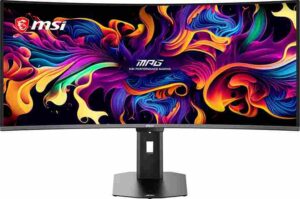
The MSI MPG 341CQR QD-OLED X36 is the monitor that gets the most attention in 2026 — and for good reason. It packs a 5th generation QD-OLED panel into a 34-inch ultrawide format at 360Hz, with a price under $900. That combination didn’t exist a year ago.
The 5th gen panel is a meaningful upgrade over previous generations. The new RGB Stripe subpixel layout virtually eliminates the color fringing that older QD-OLED panels showed on fine text. Peak brightness reaches 1,300 nits with DisplayHDR True Black 500 certification. The AI Care Sensor uses a camera to detect when you step away from your desk and automatically dims the panel to prevent burn-in — without forcing manual refresh cycles as often.
At 3440×1440 (21:9 ultrawide), games wrap naturally into your peripheral vision. Open-world games, racing simulators, and RPGs look dramatically more immersive than on a standard 16:9 screen. The 360Hz refresh rate also makes this a credible competitive gaming monitor — at 1440p ultrawide, even demanding games can reach high frame rates with a mid-to-high-end GPU.
The USB-C port delivers 98W of power delivery — the highest on this list — and the built-in KVM switch handles dual-device setups. MSI includes a 3-year warranty covering OLED burn-in.
Key Specs:
- Panel: 5th Gen QD-OLED (RGB Stripe)
- Size: 34 inches ultrawide
- Resolution: 3440×1440 (UWQHD)
- Refresh rate: 360Hz
- Response time: 0.03ms
- Peak brightness: 1,300 nits (DisplayHDR True Black 500)
- USB-C: 98W power delivery
- KVM switch: Yes
- AI Care Sensor (burn-in protection)
- 3-year warranty (burn-in included)
| Pros | Cons |
|---|---|
| Best price-to-performance on this entire list | Stock has been limited since launch — may require patience |
| 5th gen QD-OLED is the sharpest and brightest QD-OLED available | Ultrawide format isn’t ideal for users who primarily stack windows vertically |
| 360Hz ultrawide supports both competitive and immersive gaming | Some competitive games still have limited ultrawide support |
| 98W USB-C provides the highest power delivery on this list | |
| AI burn-in protection reduces forced refresh interruptions | |
| Ultrawide format is excellent for productivity and multitasking |
Best for: The gamer who wants the best all-around monitor in 2026 — immersive ultrawide gaming, competitive speed, professional color, and practical connectivity — at a price that’s hard to argue with.
MSI MAG 272UP QD-OLED X24
💰 Best Budget 4K OLED Gaming Monitor in 2026
Amazon price: Check current price | → Check latest price on Amazon
The MSI MAG 272UP QD-OLED X24 is the most affordable 4K QD-OLED monitor on Amazon in 2026. At 27 inches, 4K pixel density is at its absolute sharpest — tighter than any 32-inch 4K panel — and the QD-OLED technology guarantees the same perfect blacks and near-instant response time found in monitors costing twice as much.
At 240Hz, this monitor runs smoothly for any gaming scenario that doesn’t require 360Hz. The 27-inch 4K format is also GPU-friendly compared to larger 4K screens — modern mid-range GPUs can handle it at solid frame rates in most titles.
This is the right choice if you want the best image quality at the smallest form factor, or if you’re setting up a dual-monitor array and want a second 4K OLED without spending $1,000+ per screen.
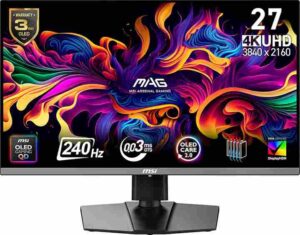
Key Specs:
- Panel: QD-OLED
- Size: 27 inches
- Resolution: 4K UHD (3840×2160)
- Refresh rate: 240Hz
- Response time: 0.03ms
- DisplayHDR True Black 400
- AMD FreeSync / G-SYNC Compatible
| Pros | Cons |
|---|---|
| Most affordable 4K QD-OLED on Amazon in 2026 | No USB-C power delivery |
| 27-inch 4K offers the sharpest pixel density available | No KVM switch |
| Compact footprint — ideal for smaller desks or dual-monitor setups | Lower brightness than premium models (True Black 400 vs 500) |
| QD-OLED quality at a more accessible price point | Limited connectivity compared to higher-end options |
Best for: Budget-conscious buyers who want 4K QD-OLED quality without paying flagship prices, and anyone building a compact or dual-monitor setup.
Final Verdict
The monitor roadmap ahead is genuinely exciting. Samsung Display has confirmed a new 34-inch panel with higher-than-4K “U+” resolution and an updated AR3.0 anti-reflective coating arriving later in 2026. More significantly, leaked roadmaps from Samsung Display — first reported by ChannelGate in March 2026 and corroborated by Videocardz — point to two brand-new QD-OLED panel sizes debuting in 2027: a 24-inch model targeting competitive and budget gamers, and a 39-inch ultrawide QD-OLED to directly challenge LG’s Tandem WOLED lineup. Both will use 4th-generation OLED emitter materials for improved brightness and efficiency. If the roadmap holds, CES 2027 in January will likely be where Samsung formally unveils them. Bookmark this page — we update it as new monitors hit Amazon.
You want the best value on the list → MSI MPG 341CQR QD-OLED X36 at $899.99. Nothing else gives you 5th gen QD-OLED, 360Hz, ultrawide, and 98W USB-C at this price.
You do creative work AND game seriously → ASUS ROG PG32UCDM. DP 2.1 UHBR20, 99% DCI-P3, KVM, and 4K 240Hz uncompressed. One monitor for everything.
You play competitive shooters at a high level → ASUS ROG PG32UCDP. The 480Hz mode exists for exactly this use case. No other monitor on Amazon offers it.
You want 4K OLED on a tighter budget → MSI MAG 272UP QD-OLED X24. 27-inch 4K QD-OLED at 240Hz. Sharp, fast, affordable.
Frequently Asked Questions
Is OLED burn-in still a risk on gaming monitors in 2026?
OLED burn-in is no longer a major concern in 2026 due to advanced protection systems like pixel shifting, AI dimming, and auto refresh cycles. Most monitors also include 3-year burn-in warranties, making real-world risk very low.
Is 360Hz actually better than 240Hz for gaming?
360Hz offers only marginal gains over 240Hz, mostly noticeable in elite competitive FPS gaming with very high frame rates. For most players, 240Hz provides nearly identical responsiveness, making it the better value and more practical choice overall.
Do I need DisplayPort 2.1 for a gaming monitor in 2026?
DisplayPort 2.1 is only necessary for uncompressed 4K at 240Hz. For 1440p or lower resolutions, DP 1.4 with DSC is sufficient. Most gamers do not need DP 2.1 unless using top-end 4K high-refresh monitors.
What GPU do I need for a 4K 240Hz or 360Hz gaming monitor in 2026?
4K 240Hz requires a flagship GPU like RTX 5080 or 5090 for high frame rates in AAA games. 1440p 360Hz needs a high-end mid GPU. Lower tiers still work but cannot fully utilize refresh potential.
Are these QD-OLED gaming monitors compatible with PS5 and Xbox Series X console gaming?
Yes, all support HDMI 2.1 for PS5 and Xbox Series X, enabling 4K 120Hz with VRR. Consoles cannot exceed 120Hz, but OLED panels still deliver superior contrast, response time, and HDR performance compared to standard displays.
