
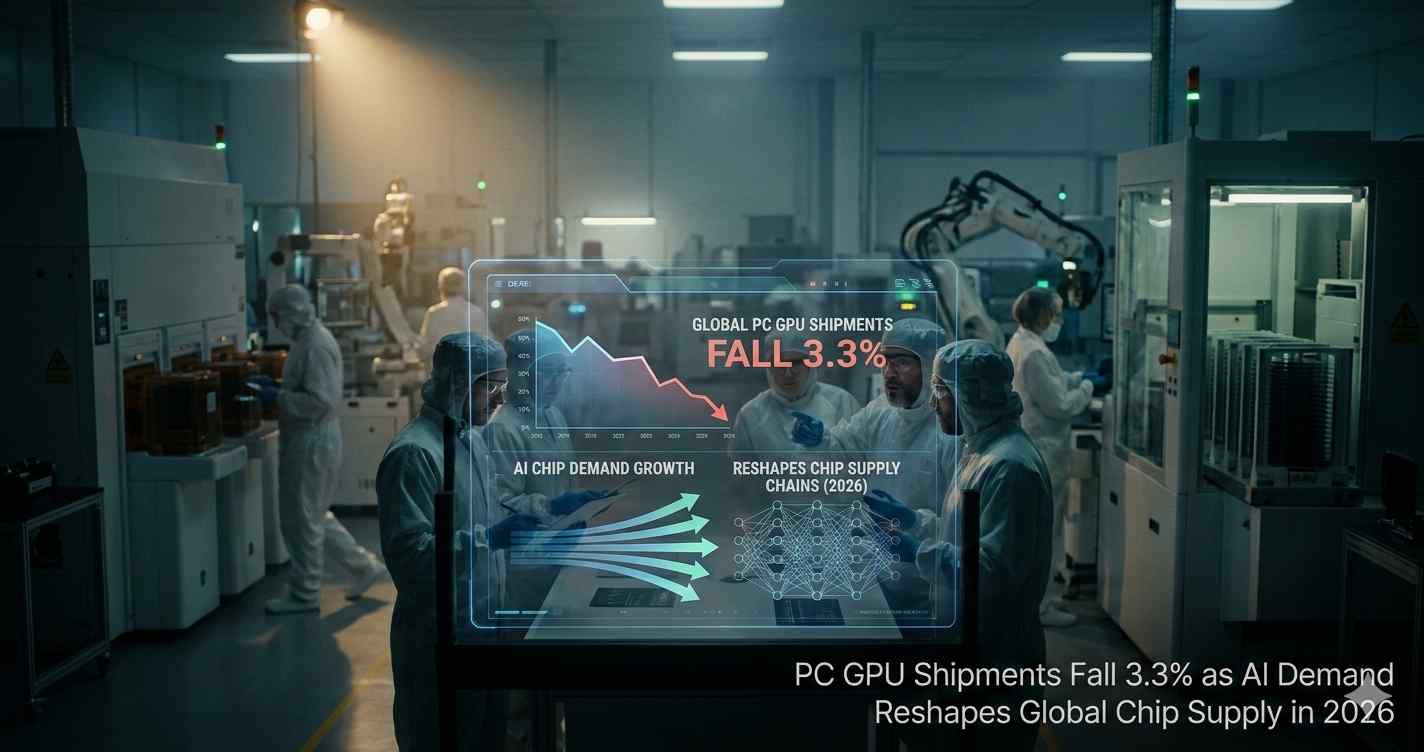
The global PC GPU market has officially entered turbulent waters. According to the latest industry data, graphics card shipments have dropped 3.3%—a figure that sounds modest on paper but masks a much deeper crisis unfolding beneath the surface.
If you have tried to buy a new graphics card recently, you already know the story: empty shelves, prices that defy reason, and a lingering question—what is actually happening?
The short answer is this: AI ate your graphics card. And the situation is about to get significantly worse before it gets better.
In this comprehensive analysis, we break down exactly why GPU shipments are falling, what the major players aren’t telling you, and—most importantly—how everyday consumers can navigate the chaos ahead.
The 3.3% Drop: A Symptom, Not the Disease
Let us start with the number that made headlines: a 3.3% decline in GPU shipments. In isolation, it is hardly catastrophic. The industry has seen worse.
But here is what the headline does not tell you: the drop is not about falling demand. It is about collapsing supply. And the supply crisis is driven by forces far larger than the gaming market itself.
NVIDIA Chief Financial Officer Colette Kress addressed this directly in the company’s quarterly earnings call: “As much as we would love to have more supply, we do believe for a couple of quarters it is going to be very tight.” When asked whether improvement might come by late 2026, her response was measured: “It is still too early for us to know”.
That is corporate-speak for: do not hold your breath.
NVIDIA CEO Jensen Huang was even blunter, warning that game graphics card supply—both desktop and laptop—would face “extreme tension” in the first half of 2026, with no clear visibility on whether the situation would improve by year’s end.
The Real Story: Why GPUs Are Disappearing
To understand why shipments are falling, you must understand what is happening inside the global semiconductor supply chain. The answer is not simple, but it breaks down into three interconnected crises.
1. The Memory Tax: AI’s Hunger for VRAM
The most immediate bottleneck is memory. Graphics cards require video RAM (VRAM)—specifically GDDR6 and GDDR7 for current-generation cards. But the same memory fabs that produce GDDR are also producing HBM (High Bandwidth Memory), the specialized memory used in AI data centers.
Here is the problem: AI data centers cannot get enough HBM. Demand is insatiable. And because HBM is far more profitable per wafer than GDDR, memory manufacturers are shifting production accordingly.
TrendForce analysts warn that the global memory industry will hit record-high production values in 2026, but that does not mean more consumer memory. It means more expensive memory, with the underlying cost of VRAM expected to remain high well into 2027.
Industry calculations reveal the brutal arithmetic: using the same GDDR7 memory for an RTX 5080 yields a $999 product with roughly 60% margin. Using that memory for an AI accelerator yields a $30,000+ system with over 75% margin. Per gigabyte, AI delivers roughly ten times the return of gaming.
2. The Foundry Shift: Wafers Go Where Money Is
Even if memory were plentiful, there is another bottleneck: the wafers themselves.
NVIDIA, like most chip designers, relies on Taiwan Semiconductor Manufacturing Company (TSMC) to produce its silicon. But TSMC’s fab capacity is finite. And every wafer used to produce a consumer GPU is a wafer not used to produce an AI data center chip.
The choice for NVIDIA is not ideological. It is mathematical. Data center revenue now dwarfs gaming revenue by a staggering margin.
Consider the numbers from NVIDIA’s latest fiscal year:
- Data center revenue: $193.7 billion
- Gaming revenue: $16 billion
The data center is now roughly twelve times larger than gaming. In the most recent quarter, gaming accounted for just 7.5% of total revenue—a stunning reversal from five years ago, when gaming was NVIDIA’s largest business.
When you allocate scarce resources, you feed the largest revenue stream first. Gaming gets what remains.
3. The Product Pivot: 8GB Becomes the New Normal
The combination of memory shortages and wafer constraints has forced NVIDIA into a defensive strategy: prioritize the products that use the least memory.
According to supply chain sources, production is pivoting heavily toward 8GB versions of the RTX 5060 and 5060 Ti, which require only four memory modules. Higher-memory models—16GB versions of the 5060 and 5070 Ti—have been drastically scaled back.
This is not what gamers want. But it is what the supply chain allows.
What This Means for Prices: MSRP Is Dead
When supply collapses, and demand remains, prices do not just rise—they detach from reality.
The official $1,999 MSRP for NVIDIA’s flagship RTX 5090 is now a historical artifact. In practice, third-party retailers across the United States, Europe, and India are pricing these cards between $3,500 and $5,000.
Even the RTX 5080, positioned as the “affordable” high-end option, is selling for $200 to $500 above MSRP—when you can find it.
The situation varies by region, but the pattern is consistent:
- United States and Germany: Severe structural shortages, with some retailers pulling high-end models from shelves entirely
- Taiwan: Inventory exists, but buyers are forced into expensive bundle deals, pushing RTX 5090 prices to the equivalent of $4,200 to $7,000
- China: A gray market has emerged for “modded” consumer cards with manually upgraded VRAM for AI development
The broader memory market adds insult to injury. DDR5 RAM prices have quintupled over the past year, though there are early signs that consumer resistance is finally slowing the climb.
The Longer Horizon: A Historic Gap
Here is the news that should worry anyone planning a future build: 2026 may be the first year in NVIDIA’s history with no new gaming GPU architecture.
Industry sources indicate that NVIDIA has delayed its next-generation Rubin architecture—what would become the RTX 60 series—until at least 2028. Even current RTX 50 series production is being scaled back, with rumors of 30% to 40% year-over-year supply reductions in early 2026.
This would create a three-year gap between GPU architectures—the longest in the history of consumer graphics.
AMD and Intel are following the same playbook. Both have pushed next-generation gaming GPU releases to 2027, synchronizing with the broader industry reality: the supply chain is simply not prioritizing consumer hardware.
Why This Is Happening Now: The AI Tipping Point
If you step back, what is happening in the GPU market is not a crisis. It is a realignment.
For decades, gaming drove graphics innovation. Gamers were the primary customers for high-performance GPUs, and their dollars funded the research and development that pushed the industry forward.
That era is over.
AI is now the primary customer. And AI does not care about frame rates or ray tracing. It cares about raw compute throughput and memory bandwidth—exactly what data center GPUs provide.
The numbers tell the story. In the most recent quarter:
NVIDIA is no longer a gaming company that also does AI. It is an AI company that still makes gaming cards out of habit.
This shift has profound implications. When Jensen Huang stands on stage at future product launches, he is not primarily talking to gamers. He is talking to cloud providers, enterprise buyers, and national governments building AI infrastructure.
Gamers are now a secondary audience
How Consumers Can Navigate the Crisis
If you are reading this as someone who needs a graphics card—for gaming, creative work, or any other purpose—the situation is undoubtedly frustrating. But there are strategies to navigate the chaos.
Strategy 1: Reset Your Expectations
The first step is accepting the new reality. Waiting for prices to return to “normal” may be a long wait. TrendForce forecasts that consumer graphics card prices will likely stay elevated well into 2027.
This does not mean you should overpay out of desperation. It means you should adjust your expectations about what “fair” pricing looks like in this environment.
Strategy 2: Consider Mid-Range and Entry-Level
If you must buy now, focus on products less affected by the memory bottleneck. Entry-level and mid-range cards—particularly 8GB models—remain relatively more available.
The RTX 5060 8GB, RTX 5050, and even older RTX 3050 models are being prioritized by manufacturers because they use fewer memory modules. These cards will not deliver 4K gaming at max settings. But they will play games, and they will be significantly easier to find.
Strategy 3: Explore the Used Market
The used market is not immune to price pressure, but it operates by different rules. Gamers upgrading from previous-generation cards often sell their old hardware, and those cards still play games.
A used RTX 3080 or RX 6800 XT may not have ray tracing performance of the latest generation, but it will run virtually any game at high settings—and it will cost considerably less than a new RTX 50 series card, if you can find one at all.
Strategy 4: Consider Cloud Alternatives
This suggestion will not appeal to everyone, but it deserves consideration: Do you need a local graphics card at all?
Cloud gaming services like GeForce Now, Xbox Cloud, and Shadow offer access to powerful hardware for a monthly subscription fee. For casual gamers or those with good internet connections, this can be a cost-effective alternative to fighting the hardware market.
For professionals—video editors, 3D artists, AI developers—cloud GPU rentals from providers like Lambda Labs, Vast.ai, and RunPod offer access to high-end hardware on an hourly basis. RunPod currently rents RTX 5090 time for $0.89 per hour.
This is not a permanent solution. But it may bridge the gap until the hardware market stabilizes.
Strategy 5: Wait—But Wait Strategically
If you can delay your purchase, delay it. But do not wait passively.
Monitor stock alerts. Join enthusiast communities that track availability. Understand which retailers in your region are most likely to receive inventory. When stock does appear, it sells out in minutes. Being prepared matters.
Also watch for signs of demand softening. In Japan, AMD Radeon RX 9060 and 9070 prices dropped up to 20% in early 2026 after hitting unsustainable highs and seeing demand collapse . Similar corrections could occur elsewhere if consumers collectively refuse to pay inflated prices.
What Governments and Regulators Are (Not) Doing
The GPU shortage has not escaped the attention of policymakers, but meaningful intervention is unlikely.
Export controls targeting China have complicated the picture further. NVIDIA reportedly reduced GPU supply to the Chinese market by approximately 30% in early 2026, partly due to shifting allocations and partly due to regulatory constraints.
For the average consumer in the United States or Europe, these geopolitical dynamics are invisible—but they shape the supply chain nonetheless.
The Bottom Line
The 3.3% drop in GPU shipments is not a blip. It is a signal of fundamental structural change in the semiconductor industry.
AI has become the dominant customer for advanced chips, and its appetite is insatiable. Memory manufacturers prioritize HBM over GDDR. Foundries prioritize AI accelerators over consumer GPUs. And NVIDIA, the market leader, has transformed from a gaming company into an AI company that happens to still sell gaming cards.
For consumers, this means:
- High prices are likely to persist through 2026 and into 2027
- Mid-range and entry-level cards will be easier to find than high-end models
- The used market and cloud alternatives deserve serious consideration
- Waiting for a “return to normal” may mean waiting years, not months
The rough sailing the GPU market has entered is not a passing storm. It is a new climate. Navigating it requires new strategies, new expectations, and a clear-eyed understanding of what is actually happening inside the global supply chain.
The sooner consumers accept this reality, the sooner they can make informed decisions about how—and whether—to participate in this transformed market.
Key Takeaways:
| Factor | Impact |
|---|---|
| AI Memory Demand | HBM production crowds out GDDR, creating VRAM shortages |
| Foundry Capacity | TSMC wafers prioritized for AI accelerators over consumer GPUs |
| NVIDIA’s Strategic Shift | Gaming now 7.5% of revenue; data center is 12x larger |
| Product Availability | 8GB cards prioritized; 16GB+ models scarce |
| Price Reality | RTX 5090 selling for $3,500–$5,000 vs. $1,999 MSRP |
| Timeline | Shortages likely through 2026; next-gen GPUs delayed to 2028 |
| Consumer Strategies | Consider mid-range, used market, cloud rentals, or strategic waiting |
