
The memory market is in crisis. RAM prices December 2025 have witnessed an unprecedented surge, with costs skyrocketing up to 500% compared to early 2024 levels. This dramatic RAM shortage 2025 has sent shockwaves through consumers and industries alike, stemming from a DDR5 price surge driven by AI demand, production bottlenecks, and supply chain fractures. This comprehensive analysis examines the root causes behind the PC builder RAM crisis, explores the profound RAM demand increase across sectors, and provides actionable strategies for navigating this historic market disruption.
The Perfect Storm: Why RAM Prices Exploded in 2025
The memory market experienced a confluence of factors that created the worst supply crisis in over a decade. Multiple industry disruptions converged simultaneously, creating constraints that manufacturers couldn’t overcome quickly enough to meet exploding demand.
1. AI Data Center Procurement: The Primary Demand Driver
Artificial intelligence infrastructure became the dominant force behind the DDR5 price surge. Major tech corporations invested hundreds of billions in expanding AI capabilities, requiring massive quantities of high-performance memory. Data centers purchasing DDR5 in bulk created demand that dwarfed all traditional consumer and enterprise markets combined.
Cloud providers like Microsoft Azure, Google Cloud, and AWS competed aggressively for available memory, often paying premium prices that reshaped memory market dynamics. This enterprise-level procurement fundamentally altered allocation priorities, leaving retail channels severely depleted.
2. Manufacturing Facility Transitions Create Supply Bottleneck
Samsung and SK Hynix, controlling approximately 70% of global DRAM production, initiated major facility transitions throughout 2024-2025. These manufacturers aggressively shifted production from DDR4 to DDR5 and next-generation technologies, temporarily reducing overall output capacity.
This transition period created a critical supply gap as older production lines were retooled and new facilities ramped up. The manufacturing bottleneck coincided perfectly with the unprecedented RAM demand increase from AI sectors, exacerbating shortages across all memory categories.
3. Geopolitical Trade Tensions Disrupt Global Supply Chains
International trade policies and semiconductor export restrictions added complex layers to the crisis. Tariffs on memory imports in key markets increased costs by 10-15%, while export controls limited the flow of advanced manufacturing equipment.
These geopolitical factors created severe regional supply imbalances, with some markets experiencing more acute shortages than others. The fragmented global supply chain prevented manufacturers from efficiently distributing inventory to where consumer demand was highest, particularly affecting PC builder RAM availability in Western markets.
Market Impact: Who’s Feeling the Pain of the RAM Shortage?
The RAM prices December 2025 crisis has created a tiered impact across different market segments, reshaping purchasing patterns and upgrade cycles worldwide.
PC Builders and Gaming Enthusiasts: The Hardest Hit
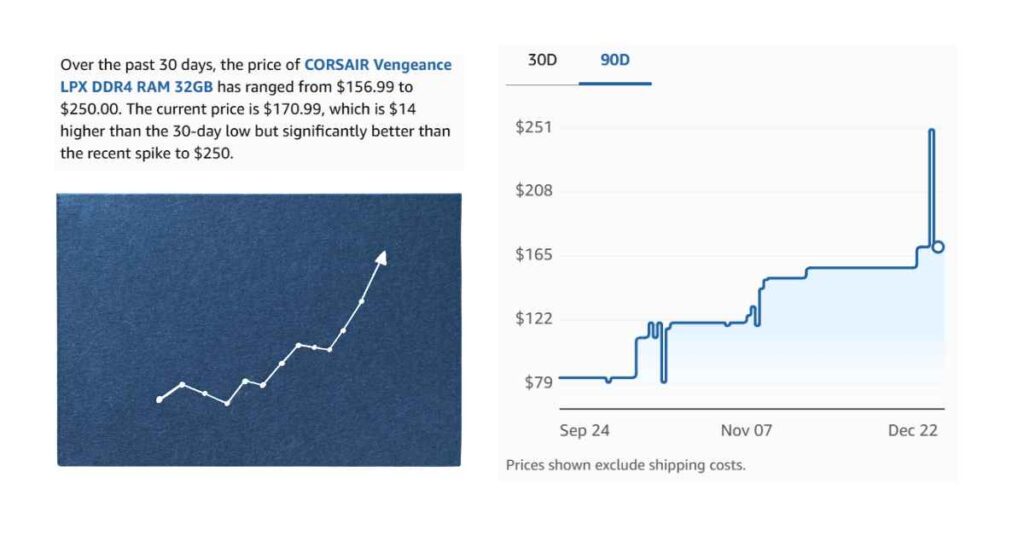
Individual system builders face the most direct impact. Mid-range DDR5 kits that sold for $80-120 in early 2024 now command $400-600, forcing many to postpone builds or compromise on specifications. Gaming system upgrades have become prohibitively expensive, with memory representing an unprecedented portion of total build costs.
The PC builder RAM crisis has led to a resurgence in used market activity and extended lifespans for older DDR4 systems. For those committed to new builds, strategic specification selection has become essential for managing costs.
System Integrators and OEMs: Margin Compression and Configuration Changes
Pre-built system manufacturers struggle with unsustainable component economics. Many OEMs have reduced base RAM configurations (offering 16GB instead of 32GB) or absorbed partial cost increases at the expense of profitability. Lead times for custom systems have extended dramatically as integrators compete for limited memory allocations.
Enterprise and Data Centers: Budgetary Pressures Meet Strategic Priority
While enterprise buyers with existing contracts maintain better access, they still face substantial cost increases. Corporate IT departments report reallocating funds from other initiatives to cover infrastructure upgrades, while some organizations delay refresh cycles entirely. The RAM demand increase from AI has created a two-tier enterprise market, with AI projects receiving priority over traditional IT infrastructure.
Regional Price Variations in the Global Memory Market
Despite the global nature of semiconductor manufacturing, significant regional disparities have emerged in how the RAM shortage 2025 manifests.
- North America: Prices increased 450-500% for mainstream DDR5. Major retailers struggle with inventory that sells out within hours. Additional import tariffs compound the supply-driven increases.
- Europe: Similar pricing trends to North America, with VAT amplifying consumer impact. Currency fluctuations against the dollar add volatility, and smaller retailers face severe allocation challenges.
- Asia-Pacific: Proximity to manufacturing provides some advantage, but export priorities to Western markets sometimes create domestic scarcity. Consumers in Taiwan, South Korea, and Japan have better access to alternative and used markets.
Supply Chain Analysis: Why Can’t Production Keep Up?
Understanding the structural vulnerabilities reveals why the memory market cannot quickly respond to demand spikes.
- Manufacturing Concentration: Three companies (Samsung, SK Hynix, Micron) control over 95% of DRAM production. This oligopoly creates systemic vulnerability when any major producer shifts priorities.
- Just-in-Time Inventory Collapse: The industry’s efficiency-focused inventory practices eliminated buffers against demand spikes. When AI-driven demand materialized, distribution channels had no reserves.
- Distribution Bottlenecks: Logistics challenges, customs delays, and freight constraints add weeks to delivery timelines. Smaller buyers find themselves deprioritized in allocation decisions, creating a tiered access system.
Price Predictions: When Will RAM Prices Return to Normal?
Short-Term (Q1-Q2 2026): Most analysts expect RAM prices December 2025 levels to persist through Q1 2026, with modest 10-20% relief possible by mid-year as new production capacity comes online. However, AI demand will continue absorbing much of the increased supply.
Medium-Term (2026-2027): Gradual improvement is expected as manufacturing ramps up throughout 2026. The DDR5 price surge should moderate as AI infrastructure buildouts reach initial completion. The potential introduction of DDR6 in late 2026 could alter pricing dynamics across generations.
Key Stabilization Factors:
- Successful ramp-up of new manufacturing facilities without yield issues
- Moderation in AI infrastructure expansion
- Improved memory utilization efficiency in AI applications
- Easing of geopolitical trade tensions
Actionable Strategies for Consumers and Builders
Navigating the current RAM shortage 2025 requires strategic adaptation.
1. Timing Your Purchase
- Wait if possible: Non-urgent builds should consider waiting until Q3 2026 for better pricing.
- Monitor aggressively: Set price alerts and watch for retailer restocks, which occasionally sell at normal markup before secondary market inflation.
- Buy strategically: If you need memory now, purchase sooner rather than later if predictions of sustained high prices prove accurate.
2. Specification Optimization: DDR4 vs. DDR5
- Choose DDR4 for value: DDR4 platforms offer 60-70% cost savings with minimal performance difference for most games and applications.
- Right-size your DDR5 purchase: If DDR5 is necessary, consider starting with 32GB instead of 64GB, leaving room for future expansion when prices normalize.
- Match memory to use case: Only professional workloads like 4K video editing, 3D rendering, or scientific computing consistently benefit from DDR5’s bandwidth advantage.
3. Alternative Sourcing and Platforms
- Explore reputable used markets: Tested modules from established sellers on hardware forums or eBay offer substantial discounts.
- Consider pre-built systems: OEMs often have better memory allocation than retail channels. In some cases, buying a complete system and reselling unwanted components costs less than building from scratch.
- Evaluate older platforms: Intel’s 12th/13th Gen or AMD’s AM4 platforms support affordable DDR4 while delivering excellent performance for most users.
Industry Response and Long-Term Mitigation
Memory manufacturers and tech companies have initiated responses to address the structural issues exposed by the crisis.
- Production Expansion: Samsung, SK Hynix, and Micron have accelerated fab construction timelines, though new capacity won’t fully impact the market until late 2026.
- Technology Innovation: Manufacturers are developing more efficient memory architectures and improved compression to maximize existing capacity utilization.
- Supply Chain Diversification: Companies are securing long-term supply agreements, and some governments have introduced semiconductor initiatives to reduce geographic concentration risk.
Conclusion:
The RAM prices December 2025 crisis represents a fundamental reshaping of the memory market driven by AI transformation. The DDR5 price surge affecting PC builder RAM budgets stems from deep structural factors: unprecedented AI demand meeting constrained supply during manufacturing transitions. While modest relief may appear in late 2026, a full return to 2024 pricing levels appears unlikely in the near term.
Consumers must adopt strategic approaches, prioritizing DDR4 platforms, exploring alternative sourcing, and carefully timing purchases. The RAM shortage 2025 serves as a stark reminder of the vulnerabilities in concentrated, efficiency-optimized global supply chains when faced with paradigm-shifting demand changes.
Frequently Asked Questions (FAQ)
Why did RAM prices increase 500% in December 2025?
Three factors converged: massive AI data center procurement creating unprecedented demand, production facility transitions temporarily reducing output, and geopolitical trade tensions disrupting supply chains. Manufacturers prioritized enterprise contracts, creating severe retail shortages.
When will RAM prices return to normal?
Industry analysts predict the shortage will persist through Q1 2026, with modest relief possible by mid-2026. However, a full return to 2024 pricing likely won’t occur before late 2026 or early 2027, depending on AI demand moderation.
Should I buy DDR4 or DDR5 RAM during the shortage?
DDR4 offers far better value—prices are 60-70% lower with minimal performance difference for most applications. Choose DDR5 only for specific professional workloads that benefit from higher bandwidth or if building on platforms that exclusively support DDR5.
How can I find reasonably priced RAM?
Monitor retailer restocks closely, set price alerts, explore reputable used markets, consider pre-built systems from OEMs, and evaluate DDR4 platforms. Acting quickly when inventory appears at standard markup is crucial.
Will prices continue increasing beyond December 2025?
Most analysts believe December 2025 represents the price peak, with stabilization or slight decreases expected in 2026 rather than further increases. However, the market remains vulnerable to additional manufacturing or geopolitical disruptions.
